7 Reasons Your Business Needs Night Vision CCTV Installation
Imagine it's early morning and you're unlocking your business. Straight away something's off. The back roller door's been forced. Stock is missing. You pull up the CCTV footage on your phone — and you're staring at a black screen with shapes moving through it. No face. No plates. Nothing police can work with.
That's not a hypothetical. It happens to business owners every single week — and in most cases, the cameras were running the whole time. They just couldn't produce footage that was worth anything.
This is exactly the problem that a professional night vision CCTV installation is designed to solve. Not just cameras that record in the dark, but systems that produce clear, identifiable, evidential-quality footage — the kind an insurer will accept, police can act on, and a magistrate won't throw out.
Most businesses have cameras. Far fewer have cameras that actually work after dark. Standard systems without proper night vision produce footage so grainy and dark it gets rejected at exactly the moment you need it most.
Here are the 7 reasons your business needs night vision CCTV — from deterring after-hours theft in industrial areas, to meeting QLD compliance obligations for licensed premises and childcare centres.
Reason 1: Most Commercial Break-Ins Happen After Dark
The overwhelming majority of commercial break-ins in Queensland happen in the late evening and early morning hours — when your business is empty, your staff are home, and there's nobody watching. That's exactly when your security system needs to perform at its best. And for most businesses running standard cameras, it's precisely when the system fails.
Why Standard Cameras Fail at Night
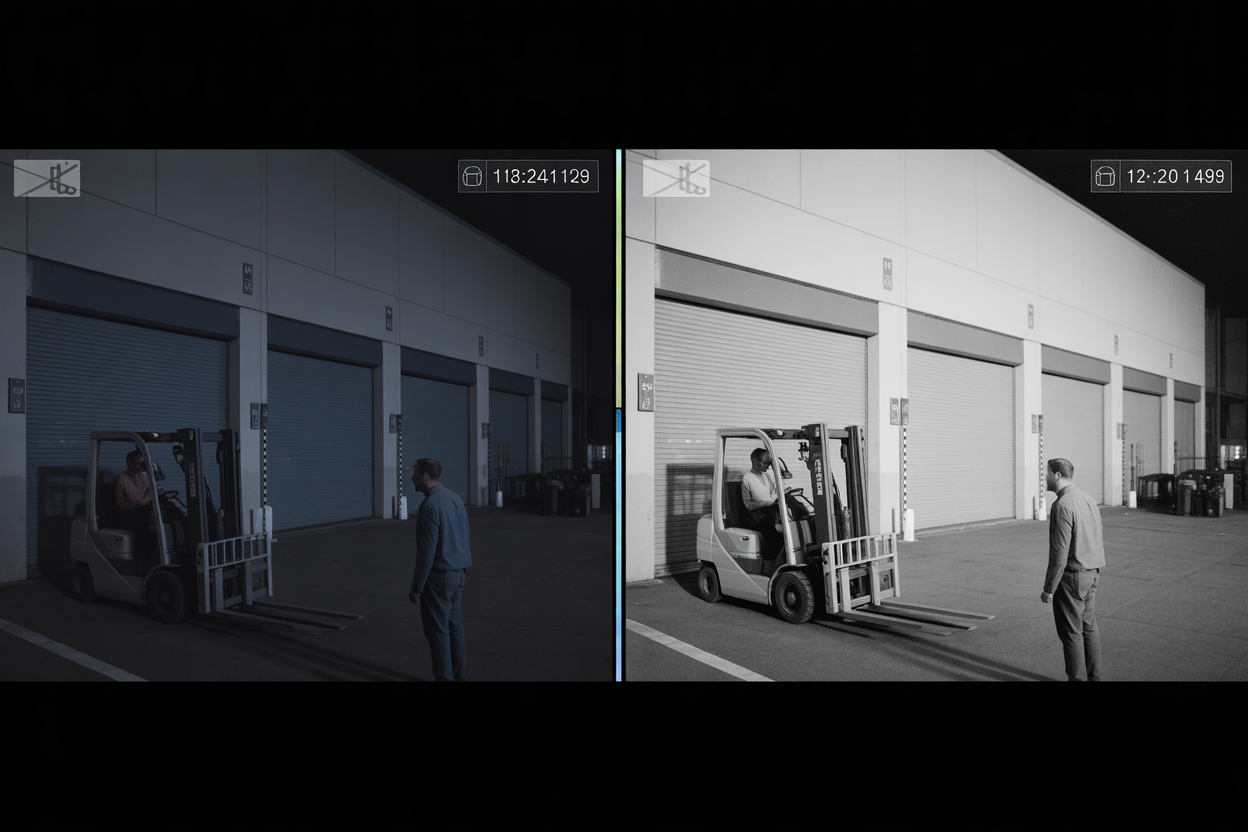
Standard CCTV cameras perform well in daylight. Push them into low-light conditions and you get dark, washed-out, pixelated footage that's useless for any practical purpose. There are two main night vision technologies worth understanding:
Infrared (IR) night vision — uses IR illuminators to light the scene. Footage is black and white but can be sharp and detailed at the right spec
Color night vision — uses advanced sensors and ambient light to produce color footage in low-light. Better for identifying clothing and vehicle color
An experienced installer will spec the right technology for each camera position — it's not a one-size-fits-all decision.
What "Evidential Quality" Footage Actually Means
Not all footage is created equal. When police or an insurer request footage, there's a minimum standard it needs to meet:
Minimum 2MP resolution (1080p) — anything less and facial identification becomes unreliable
25 frames per second minimum — lower frame rates produce jerky footage where a face may never be clearly captured
Correct lux rating for the environment — a camera rated for indoor low-light won't perform the same in an open outdoor car park
NVR retention of at least 31 days — required for QLD licensed premises compliance
One warehouse owner learned this the hard way. Three separate tool thefts — each captured on camera, each too dark to be usable. Police couldn't identify anyone. After upgrading to a properly spec'd night vision CCTV installation, the next incident produced a clear face and a readable licence plate. Police made an arrest. Same camera positions. Completely different outcome.
"If your footage can't identify a face or read a license plate after dark, you don't have a security system — you have documentation that something went wrong."
And it's not just about capturing incidents after they happen — the right system stops them before they start.
Reason 2: Night Vision CCTV Deters Opportunistic Criminals Before They Act
There's a reason professional installers talk about camera visibility as much as camera capability. A system that produces brilliant footage but nobody knows is there is only doing half the job. Deterrence is arguably the most cost-effective thing a security camera does — a prevented incident has no excess, no police report, no insurance claim, and no downtime.
How Visible Cameras Change Criminal Behaviour
Opportunistic theft is driven by a simple risk calculation: is the reward worth the risk of getting caught? Visible, professional cameras shift that calculation instantly. A well-mounted camera housing with an active IR illuminator glowing in the dark signals that this premises is monitored, the footage will be usable, and the risk of identification is high. Most opportunistic offenders move on to an easier target.
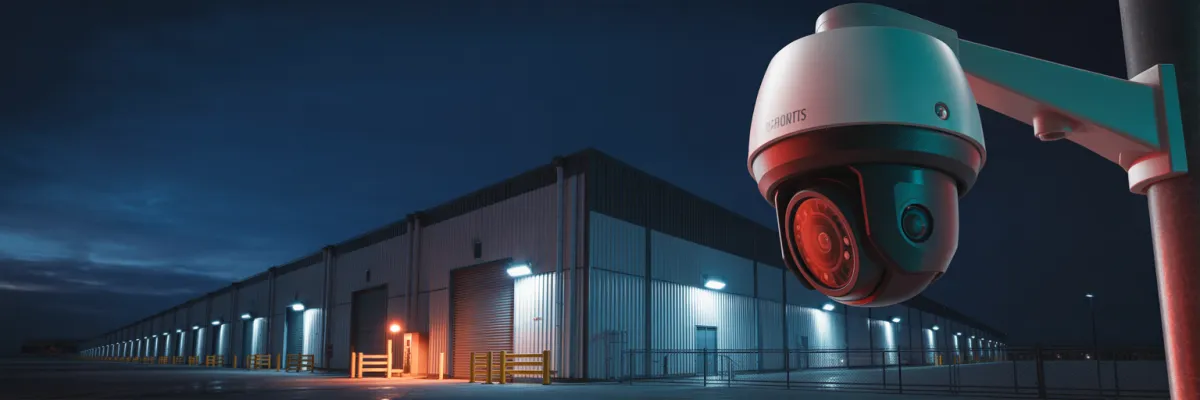
When a quality night vision camera runs after dark, the IR illuminators show as a faint red glow on the camera housing. To anyone approaching at night, that glow means one thing: active monitoring. A camera that looks dormant or cheap sends the opposite message. Professional-grade cameras communicate competence — and competence is a deterrent.
The businesses that get hit repeatedly tend to share one characteristic. Their security setup looks like an afterthought. Cameras that are old, mounted poorly, or obviously inadequate tell would-be offenders the owner hasn't invested in this. Professional night vision CCTV installation sends the opposite message.
Deterrence at the front door means nothing if your loading dock and car park remain invisible after dark.
Reason 3: Protect Your Car Park, Loading Dock, and Rear Entry Points
Ask any experienced commercial CCTV installer where break-ins happen most often, and you'll get the same answer almost every time. Not the front door. Not the main entry with the signage and the shopfront lighting. The back.
Loading docks. Rear roller doors. Car parks without adequate lighting. Side entries that aren't visible from the street. These are the spots that get exploited — repeatedly — because they're the spots that get forgotten when a security system is put together on the cheap.
Why Blind Spots Cost Businesses
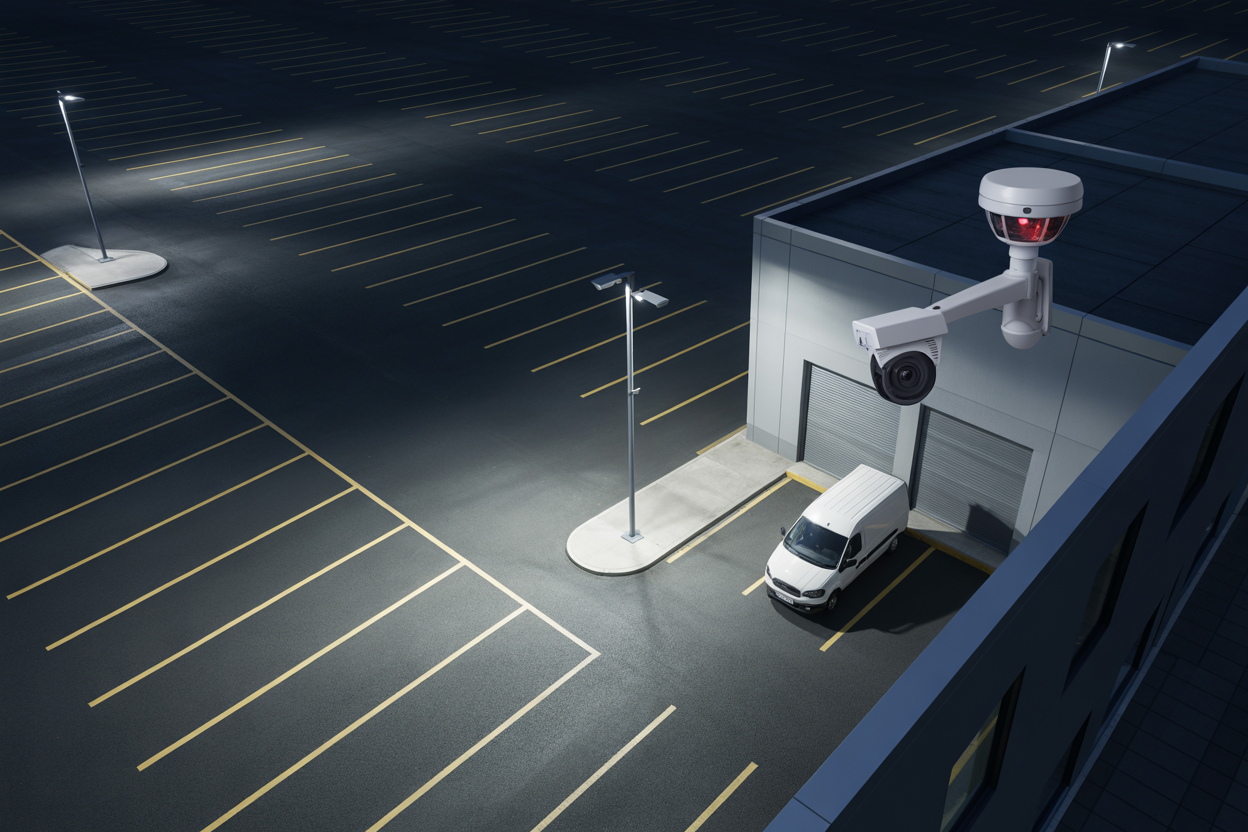
A blind spot isn't just a gap in coverage — it's an invitation. Car parks and loading docks are the number one exploited blind spot in commercial properties. They're poorly lit, away from street visibility, and the last thing businesses think about when planning a camera layout. They're also where the most expensive incidents happen — vehicle break-ins, freight theft, and slip-and-fall claims that conveniently occur just outside the coverage zone. Rear entries are particularly vulnerable because neighbouring businesses aren't covering them either.
Camera Placement for Maximum Night Coverage
Getting night coverage right in a car park or loading dock isn't just about pointing cameras in the right direction — it's about matching the right technology to each specific environment:
Field of view vs IR illumination range match — mismatched specs produce footage that's clear in the centre and black at the edges
Mounting height and angle for facial recognition — too high and you're getting top-of-head shots that are useless for identification
Overlap zones between adjacent cameras — every metre of your perimeter should be covered by at least one camera
Glare management — vehicle headlights and dock lighting can wash out standard cameras without proper wide dynamic range (WDR) settings
Number Plate Recognition in Low-Light Conditions
A readable license plate is often the single most actionable piece of evidence from a commercial incident. Police can run a plate quickly. A fraudulent injury claim evaporates when footage shows the claimant driving away normally after the alleged incident. Proper ANPR requires a specific minimum lux rating that standard cameras simply don't meet after dark — you need a camera spec'd specifically for that entry point or you'll get a blurry plate that's just as useless as no plate at all.
Reason 4: Meet QLD Compliance Obligations for Licensed and Regulated Businesses
For most business owners, CCTV is about protection and peace of mind. But for licensed venue operators, childcare centre directors, pharmacy owners, and businesses with WHS obligations — it's also about staying on the right side of Queensland regulators.
The compliance requirement isn't just "have cameras." It's have cameras that meet specific technical standards. Resolution, coverage zones, retention periods, and low-light performance are all part of it. A system that works fine during the day can still fail a compliance audit if it can't produce usable footage during an early morning childcare drop-off or a late-night incident at a licensed venue.
ACECQA Requirements for Childcare Centres
Childcare centers face equally specific obligations. Early morning drop-offs can happen in near-darkness. Late pickups push into low-light conditions for much of the year. Coverage that performs well in summer daylight can fail completely during a winter morning drop-off. If a child safety incident or unauthorised collection occurs in those conditions and your footage is unusable, the regulatory and legal exposure is significant.
WHS Documentation Obligations
For businesses with Work Health and Safety obligations — which in Queensland covers virtually every employer — CCTV footage is increasingly the primary mechanism for documenting workplace incidents. Footage that's too dark to be useful leaves you exposed to fraudulent or exaggerated claims with no documented evidence to defend yourself.
Reason 5: Remote Monitoring That Actually Works at Night
Remote monitoring is only as good as the footage being streamed. If your cameras can't produce a usable image after dark, your remote monitoring capability effectively switches off at sunset. You're not watching your business — you're watching a dark screen with shapes in it.
What to Expect From a Modern System
A modern commercial CCTV system should deliver a clean iOS and Android app, live view without buffering, motion-triggered push alerts to your phone, simple footage export, and remote playback without lag. When a motion alert fires in the middle of the night and you open the app, you need to see a clear image — not a black screen. If a system requires an IT contractor to pull footage or the app is too difficult for staff to use, it's not fit for purpose. Independence after handover isn't a bonus feature — it's a basic requirement.
Live Alerts vs Recorded Playback
Live alerts are about real-time response — motion is detected, you're notified, and you decide whether to escalate. Recorded playback is about evidence — finding the footage and exporting it when needed. A good commercial system handles both. NVR storage configuration matters here:
Reason 6: Reduce Your Business Insurance Premium With Documented Night Security
Most business owners know, at least vaguely, that having CCTV can help with insurance. What fewer realise is that the type of CCTV matters — and that a system without credible night vision capability is increasingly being flagged by underwriters as an inadequate security measure.
The businesses that actually see a premium reduction document it properly and present it at renewal as evidence of reduced risk. That package includes the installation invoice, system specification sheet showing IR capability and NVR retention period, the QBCC licence number of the installing company, and photos showing coverage of key risk areas. When you hand that to your broker, you're giving them something concrete to take to the underwriter. That's a different conversation to "yeah we've got cameras."
Underwriters are aware that most commercial incidents happen after dark. A system that demonstrably covers those hours is a meaningfully lower risk profile than one that doesn't. There's also a tax angle worth mentioning — a commercial CCTV installation is treated as a depreciable asset under ATO guidelines. Talk to your accountant, but the after-tax cost is meaningfully lower than the sticker price.
Reason 7: One Incident Pays for the Entire System
One break-in, one fraudulent claim, one theft you can't prove, one compliance audit you fail — and the cost of not having a proper system becomes very real, very fast.
Why Professional Installation Beats DIY
A DIY system from a consumer electronics retailer might look similar on paper — same camera count, similar resolution specs on the box. But the footage it produces after dark rarely meets the evidential quality standard that police and insurers require. Consumer-grade cameras aren't rated for commercial use. The IR illuminators are weaker, the lux ratings aren't appropriate for the environments they're used in, and the NVR retention isn't configured correctly.
A professionally installed commercial night vision CCTV system is spec'd for your specific environment, mounted at the correct height and angle, and configured to retain footage for the periods your compliance obligations require. That's what turns a security camera into actual evidence.
One retail store dealt with repeat after-hours break-ins through their rear entry. At insurance renewal, their broker flagged inadequate night coverage as a risk gap. A night vision install covering the rear entry, car park, and POS area followed. No further incidents. Premium reduced at the next renewal.
What to Do Next
Night vision CCTV isn't a luxury upgrade — it's the baseline standard for any system that needs to perform when it matters most.
The seven reasons covered in this guide aren't abstract. They're the exact scenarios playing out for business owners every week — break-ins with no usable footage, compliance audits failed on low-light specs, fraudulent claims with no evidence to fight back with. Every one of those outcomes is preventable.
A professional night vision CCTV installation needs to be right — correctly spec'd for your environment, properly mounted for evidential footage, and configured so you can actually use it when you need it most. That's exactly what we do.