AI Security Camera Installation: Is It Worth the Cost?
You've seen the ads. Cameras that detect faces, read licence plates, and send you an alert before anything's actually been stolen. It sounds impressive. But is AI security camera technology actually ready for a warehouse, retail store, or hospitality venue — or is it expensive gear that looks great in a brochure and underwhelms in practice?
That's a fair question to ask. And it's one a lot of business owners are sitting with right now.
AI-enabled security cameras have moved from large-enterprise territory into the small-to-medium business market over the past couple of years. The apps are more reliable, and the use cases — detecting intruders before they breach the perimeter, flagging loitering near high-value stock, reading licence plates at vehicle gates, identifying tailgating through access points — are directly relevant to the kinds of incidents businesses actually deal with.
But "AI camera" is also one of the most overused terms in the security industry right now. Not every camera marketed as AI-powered delivers meaningful capability. And for some businesses, a well-placed conventional IP system, configured properly by a licensed installer, will outperform an AI setup that's been undersized or set up wrong.
This guide breaks down what AI security camera installation actually involves, which business types get the most out of it, and how to decide whether it's the right investment for your operation right now — or whether a high-quality conventional system is still the smarter call.
What Is an AI Security Camera?
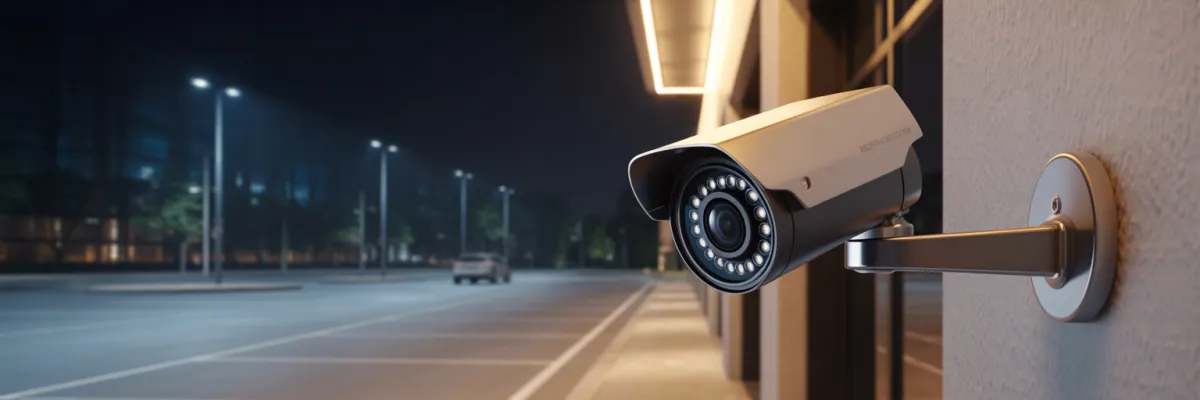
An AI security camera is a surveillance camera that uses artificial intelligence to analyse footage in real time — rather than simply recording and storing it for later review.
Unlike traditional CCTV, which requires a person to manually scrub through footage after an incident, AI cameras process what they see continuously and can:
Detect specific objects or behaviours — people, vehicles, loitering, tailgating, or unattended bags
Send instant alerts to your phone when a defined trigger occurs — before an incident escalates
Read license plates automatically and flag unregistered or blacklisted vehicles
Distinguish between humans and animals — reducing false alarms from wildlife, insects, or moving trees
Learn patterns over time — identifying what's normal for your site and flagging anything that isn't
How Do AI Security Cameras Actually Work?
Understanding the technology behind AI cameras matters, because it directly affects how reliable the system is going to be for your business — and how it performs when your internet drops out at 2am on a Saturday.
On-Camera Processing vs Cloud Processing
There are two ways an AI security camera can run its analytics — and the difference between them matters more than most installers explain upfront.
Edge processing means the AI runs directly on the camera itself. The camera analyses footage locally, without needing to send data to a remote server. If your internet connection drops during a storm, the camera keeps detecting, keeps recording, and keeps alerting via any available local network connection.
Cloud processing means the camera sends footage to a remote server, where the AI analysis happens. This requires a stable, fast internet connection at all times. If your connection goes down, the analytics go with it. You're still recording to local storage, but the intelligent detection layer is offline.
For most commercial premises, edge-processing cameras are the more resilient option. They're not dependent on internet stability, they introduce less latency in alert delivery, and they keep your footage data on-site rather than on a third-party server — which matters if your business handles sensitive client information.
What AI Cameras Are Actually Detecting
The detection capabilities vary by camera grade and configuration, but across commercial-grade AI systems, the core functions include:
Object detection — identifying and categorizing people, vehicles, and specific items in frame
Behavioral detection — flagging loitering near a perimeter, tailgating through an access point, or unusual movement patterns after hours
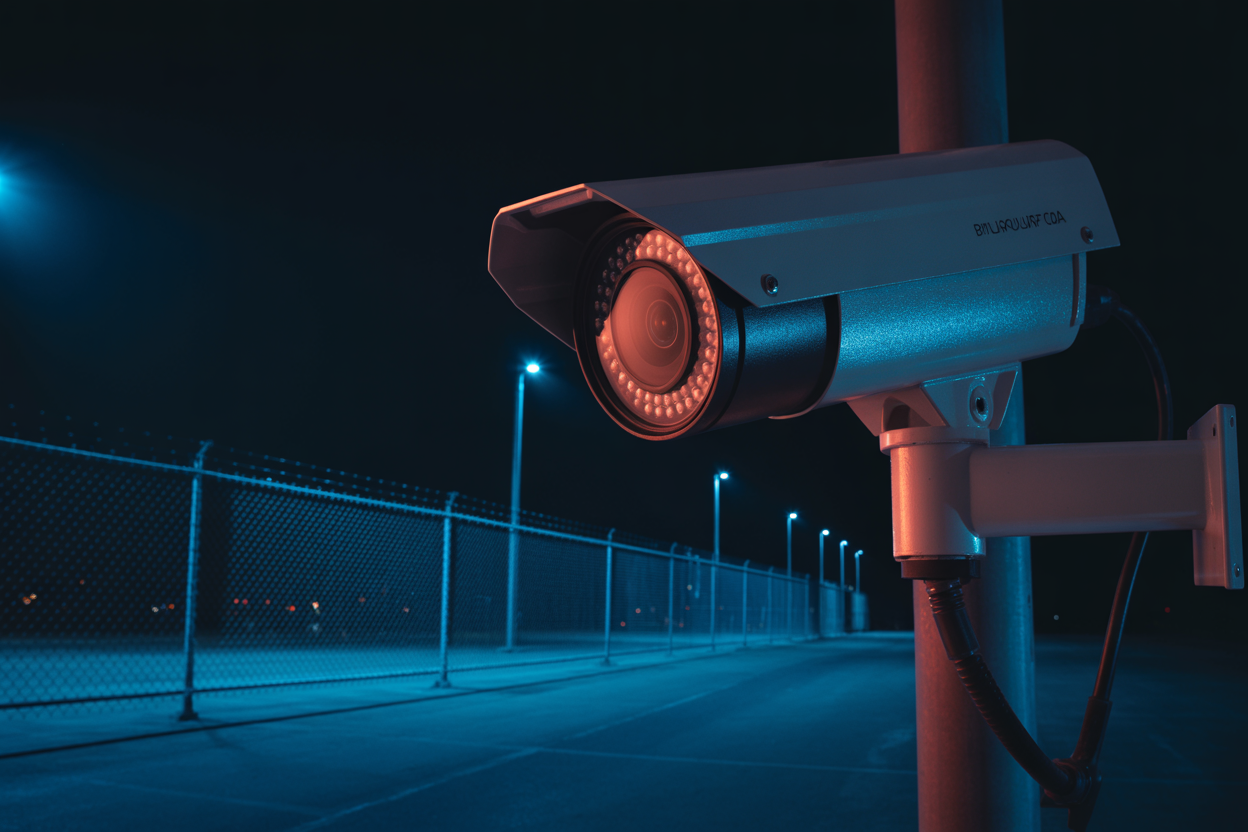
License plate recognition (LPR) — automatic, searchable, timestamped logs of every vehicle entering or exiting your site
Anomaly detection — the camera learns what normal looks like at your site and flags deviation from that pattern
It's not magic. It's pattern recognition at a processing speed no human could match reviewing footage manually.
How the Alert System Works
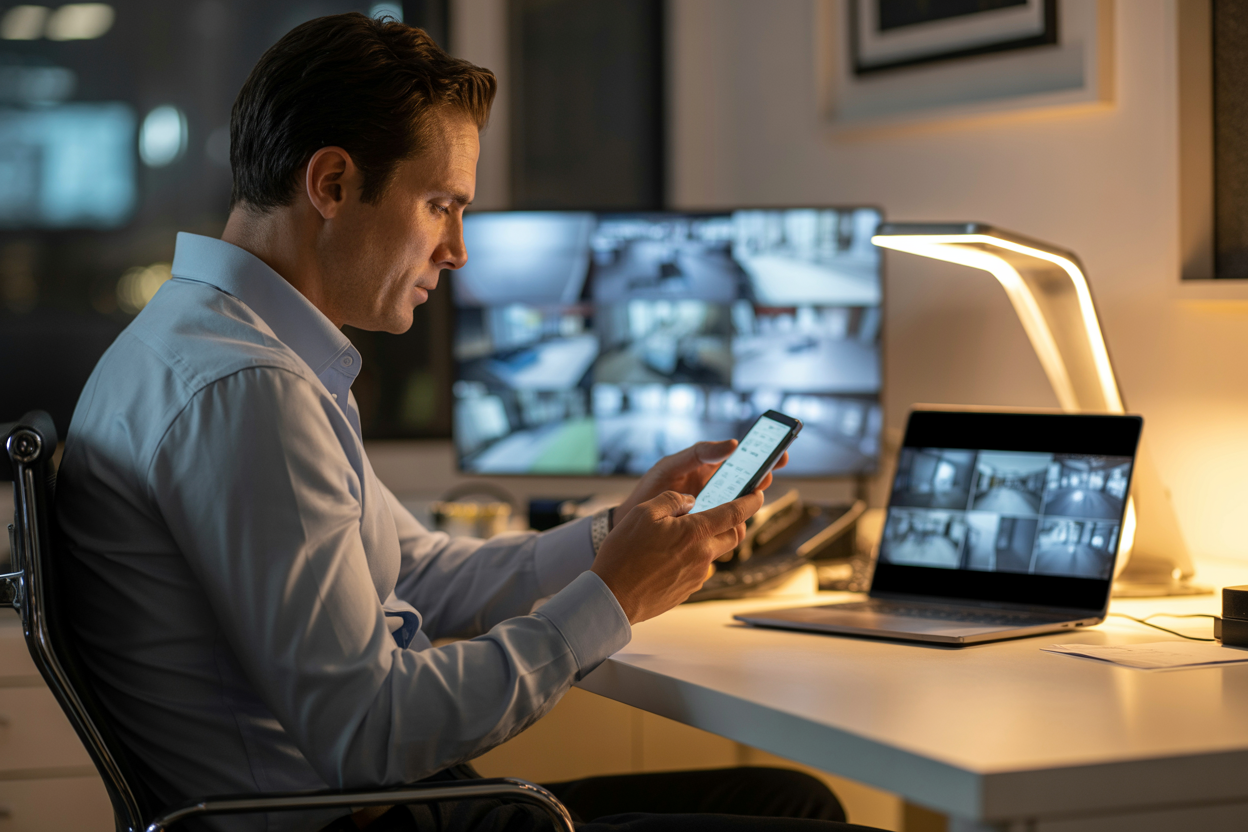
The workflow is straightforward. Camera detects a trigger → pushes a notification to your phone → you open the app and review the live feed or the clipped recording of the event.
You're not woken up by a neighbour or a call from the police. You get a notification, you open the app, you see exactly what's happening or what just happened, and you decide whether to call triple-zero or roll over and go back to sleep because it was a possum on the fence line.
The app is also where AI cameras live or die in real-world use. A camera with excellent detection capability and a poorly designed app is genuinely frustrating to operate. App reliability — iOS and Android, live view and historical playback, footage export — should be a specific question you ask before you commit to a system.
AI Security Cameras vs Traditional CCTV — What's Actually Different?
Most business owners already have some form of security camera installed. The real question isn't whether AI cameras exist — it's whether they're meaningfully better than what you've already got, and whether that difference justifies the investment of upgrading.
Recording vs Real-Time Analysis
This is the fundamental gap between the two systems.
Traditional CCTV is passive. It records continuously and sits there waiting for you to need it. When something goes wrong — a break-in, a staff incident, a slip-and-fall — you go back through the footage to find out what happened. The system documents events. It doesn't respond to them.
AI cameras are active. They're analysing footage continuously and responding to what they detect in real time. One system tells you what happened after the fact. The other tells you what's happening while it's happening — and gives you the chance to do something about it before the damage is done.
For a business owner who can't be on-site 24/7, that distinction is significant.
Image Quality and Evidence Standards
Commercial-grade AI cameras typically operate at 4K resolution or higher. That means footage that clearly identifies faces, reads vehicle registration plates, and meets the evidence quality threshold required for police submissions and insurance claim documentation.
Contrast that with the analogue systems a lot of businesses are still running — systems that produce footage so degraded it's practically useless. Blurry, pixelated recordings that can confirm something happened but can't tell you who did it or what they took. Insurance companies know what inadequate footage looks like. So do police.
If your current system can't produce footage that clearly identifies an offender, it's not really a security system — it's a recording of your losses.
False Alarm Rates
Traditional motion detection is indiscriminate. Wind moving through a tree, a shadow shifting across a carpark, an insect flying past the lens — all of it triggers an alert. After a week of that, most business owners turn the alerts off entirely. The system becomes a passive recorder again, which defeats the purpose.
AI cameras distinguish between human movement and environmental triggers. A person crossing your perimeter in the middle of the night triggers an alert. A possum on the fence line doesn't. Alert fatigue is real, and it's one of the main reasons traditional motion-detection systems fail in practice even when the hardware is working perfectly.
Storage and Retrieval
Traditional CCTV records continuously. Finding a specific incident means scrubbing through hours of uninterrupted footage — time most business owners don't have, and patience that runs out fast when you're already dealing with the aftermath of an incident.
AI systems use event-based recording. The camera stores clips triggered by detected events, organised by object type, time, and location. Finding the specific moment someone entered a storage room after hours? That's a quick task, not a two-hour one.
Open the app. Find the incident. Save the clip. Send it to the police. A properly configured AI system meets that requirement every time.
Comparison Table — AI Camera vs Traditional IP vs Analogue
Which Businesses Benefit Most From AI Camera Systems?
AI security camera installation isn't a one-size-fits-all solution. The businesses that get the most out of it tend to share a few common characteristics — after-hours risk, high-value inventory, compliance obligations, or a history of incidents where better footage would have changed the outcome.
Warehouses and Industrial Sites
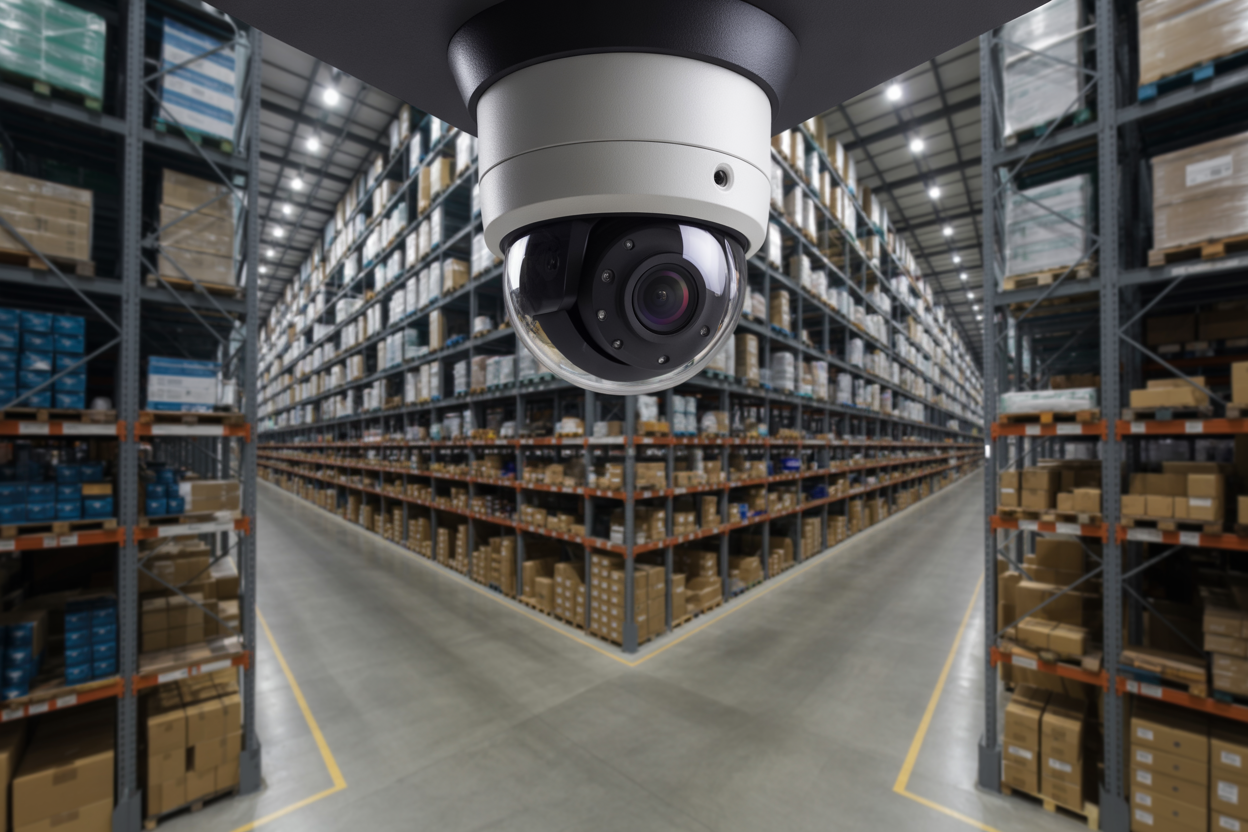
If there's one business type where AI cameras deliver an almost immediate return, it's warehouses and industrial facilities. These are sites that often operate with minimal overnight staffing, large perimeters, multiple entry points, and high-value assets sitting in the open. After-hours theft of tools, fuel, copper, and freight is a real and ongoing problem across industrial areas.
AI perimeter detection changes the equation. Instead of discovering the next morning that someone cut through the fence and loaded your copper into a ute, the camera detects movement at the perimeter line and pushes an alert before the offenders have reached the asset. That's the difference between a police response and a police report.
License plate recognition at vehicle gates creates an automatic, timestamped log of every vehicle entering and exiting the site — useful for insurance, subcontractor accountability, and any dispute about who was on-site and when.
Retail Stores
Retail theft isn't always dramatic. A lot of it is quiet, repeated, and done by people who've figured out where your blind spots are. Shoplifters case a store before they act — they know which aisles the cameras don't cover, they know when staff are busy at the register, and they know how to conceal product without triggering obvious suspicion.
AI cameras address this differently to conventional systems. Behavioural detection flags loitering near high-value displays — the person who's been standing in the same aisle for several minutes without picking anything up. Coverage of POS counters with timestamp-matched transaction records ties camera footage directly to your point-of-sale data.
Hospitality Venues
Hospitality venues operate under specific legal obligations that make AI camera capability directly relevant. The QLD Liquor Act mandates specific CCTV requirements for licensed premises, including coverage areas, image quality standards, and footage retention periods.
AI systems can automatically generate timestamped incident logs — exactly the kind of audit-ready documentation licensing authorities require. Crowd density monitoring at entry points helps venues manage capacity and identify potential incidents before they escalate. After-hours perimeter alerts cover the period after close when staff have left and the premises are most vulnerable.
Healthcare and Childcare
Healthcare and childcare facilities carry privacy obligations that make camera placement genuinely complex — but they also carry compliance requirements that make a properly configured system non-negotiable.
For childcare centres, ACECQA compliance requirements include specific standards around footage retention. AI systems meet those retention requirements automatically, with timestamped records that are retrievable without manual effort. The sensitivity around camera placement in these environments is real — this isn't a job for an installer who doesn't understand the regulatory context.
Construction and Trade Sites
Construction sites present a specific challenge: the security need is real, but the site itself changes constantly. Permanent infrastructure doesn't always make sense.
Mobile and solar-powered AI cameras solve this. They can be repositioned as the site develops, require no fixed power or network infrastructure, and deliver the same perimeter detection and alert capability as a permanent installation. Tool and material theft from construction sites is opportunistic — offenders target sites that look unmonitored. Visible AI cameras with active detection change that calculation.
Is AI Security Camera Installation Worth It? The Honest Answer
It's not the same answer for every business, and pretending otherwise wouldn't be doing you any favours.
When AI Cameras Are Absolutely Worth It
High-value inventory or frequent after-hours incidents. If the cost of one break-in exceeds the cost of the system — the maths are already done. A single prevented incident pays for the installation. Everything after that is pure return.
Alert fatigue from traditional motion detection. If you've already got a conventional system and you've stopped responding to alerts because they've cried wolf too many times — you've already lost the benefit of having cameras. AI detection fixes the underlying problem rather than papering over it.
Compliance obligations requiring documented, timestamped incident logs. If you're a QLD liquor licence holder, a childcare operator with ACECQA obligations, or a business with WHS documentation requirements — an AI system meets those obligations automatically, without manual effort on your part.
Multi-site operators needing centralised monitoring. Managing security across multiple locations without dedicated security staff is significantly easier with AI cameras and centralised app management. That's not a luxury for a multi-site operator — it's a practical necessity.
When a Quality Conventional IP System May Be the Better Call
If you're running a small, single-entry premises with low after-hours foot traffic and minimal stock risk — a well-specified conventional IP system, properly placed and configured by a licensed installer, will do the job without the AI premium.
If the choice is between a properly installed conventional system and a poorly configured AI one — take the conventional system every time. Placement and configuration matter more than technology tier. A well-placed camera in the right position beats a high-spec AI camera pointed at the wrong wall.
Saying this costs a sale occasionally. That's fine. Business owners who get an honest recommendation come back — and they refer their contacts. That's worth more than one oversold installation.
One Last Thing Before You Decide
The question was never really "should I get AI cameras?" The question was always "what would have happened differently if I'd had them already?"
The break-in that left you with no usable footage. The staff incident you couldn't act on because you couldn't prove it. The insurance claim that cost you an excess because the footage wasn't clear enough to identify anyone. These aren't hypothetical scenarios — they're the exact situations that send business owners to Google in the first place.
AI security camera installation isn't a technology purchase. It's a decision about what kind of evidence you'll have available on the worst day your business has this year. Whether that day involves a break-in at your warehouse, a staff dispute at your retail store, or a compliance audit of your venue — the footage either exists in a form that's usable, or it doesn't.
A well-specified, professionally installed AI camera system means it does.
That's the honest case for it. Not the megapixels, not the app interface, not the brand names — the simple fact that when something goes wrong, you have clear, timestamped, exportable evidence that changes the outcome.