Home Security Camera Angle Optimization: The Complete Brisbane Homeowner's Guide to Maximum Protection
You've finally invested in security cameras for your Brisbane home, but here's the problem nobody talks about: a poorly angled camera is just an expensive ornament that won't protect your family when you need it most.
Last week, a Kenmore family discovered this the hard way. Their $2,400 camera system captured crystal-clear footage of their fence... while burglars entered through a completely unmonitored side gate. The blind spot cost them $8,000 in stolen property.
Home security camera angle optimization isn't about having more cameras—it's about positioning them strategically to eliminate blind spots, maximize coverage, and actually capture usable footage when something happens.
In this guide, you'll discover exactly how to position your security cameras for complete property protection. We'll cover the critical angles professional installers use, common blind spots Brisbane homeowners miss, and the simple adjustments that can double your effective coverage.
Why Security Camera Angles Matter More Than Camera Quality
Michael and Emma from Kenmore Hills spent $3,200 on top-of-the-line 4K cameras. Three months later, their garage was broken into. The footage? Perfect high-definition shots of the burglar's hat—completely useless for identification.
The problem wasn't the camera quality. Michael mounted them at 3.5 meters high and angled almost straight down. When we repositioned those same cameras with proper angles, they went from useless to providing complete property coverage. A $200 camera positioned correctly will outperform a $800 camera positioned poorly every single time.
Professional security camera positioning follows the "face capture zone"—that sweet spot between 2.5 and 3 meters high, angled downward at 15-30 degrees. This captures both facial features AND body movement in the same frame.
Brisbane-specific factors matter too. Afternoon sun between 3-6pm washes out western-facing cameras. Summer storms create water droplets on horizontal lenses. According to our installation data, 73% of DIY camera setups have at least one critical blind spot that proper angle planning would've prevented.

The 5 Critical Angles Every Brisbane Home Needs Covered
#1 - Front Entry & Porch Coverage
Mount your camera 2.7-3 meters high, positioned 2-3 meters to the SIDE of your door (not directly above it). Angle at 20-25 degrees downward. This captures faces as people approach, their full body at the door, and the entire porch area.
#2 - Driveway & Vehicle Protection
Position at the top corner of your garage, angled to catch vehicles approaching from the street. Angle 25-30 degrees downward, covering from street entry to garage door. For night coverage, angle slightly to the side to avoid headlight glare.
#3 - Backyard & Rear Access
According to Queensland Police data, 68% of break-ins happen through rear entry points—yet only 40% of homes have properly angled rear cameras. Mount 2.8-3 meters high on the opposite corner from the back door, angled at 20-25 degrees. This captures both approach and door activity.
#4 - Side Gates & Access Points
Side gates are the most overlooked entry point. Mount at the END of the side passage looking back toward the gate entry, 2.8-3m high at 30 degrees downward. This creates a chokepoint where anyone walking through must pass directly through your camera's optimal recognition zone.
#5 - Garage & Shed Coverage
Your garage contains $10,000-$30,000 worth of valuables. Position cameras high on the garage wall angled to capture both approach and entry at 25-30 degrees. Remember: Brisbane garages hit 45+ degrees in summer—use cameras rated for Australian conditions.
The Science of Security Camera Angles: Heights, Distances & Coverage Math
The 15-30 Degree Rule
The best camera angles for home security fall between 15 and 30 degrees downward from horizontal. At 15 degrees, you get maximum ground coverage but people further away are too small to identify. At 30 degrees, you get excellent facial capture but coverage area shrinks. The sweet spot? 20-25 degrees—decent coverage AND clear facial recognition.
When someone approaches at 20-25 degrees, you're capturing them from 8-10 meters away until they're at your doorstep. That's enough footage to see their gait, what they're carrying, and all the details police need.
Optimal Mounting Heights
Standard recommendation: 2.5-3 meters for most applications.
Front doors/porches: 2.7-2.8 meters
Driveways/open areas: 2.8-3 meters
Side passages/gates: 2.5-2.7 meters
Backyard coverage: 3 meters
One Kenmore family had cameras at 4 meters because "it looked professional." All they captured was hat tops. We dropped them to 2.8 meters—suddenly they could see faces.
Brisbane-Specific Environmental Factors
Sun position: Western-facing cameras get hammered by glare between 3-6pm. Angle them 5-10 degrees away from direct sun or invest in WDR (Wide Dynamic Range) cameras.
Summer storms: Water droplets pool on horizontal lenses. A steeper angle (25-30 degrees) helps water run off naturally.
Tree growth: Brisbane's subtropical climate means fast-growing vegetation. Position cameras with buffer zones for seasonal foliage changes.
Common Camera Angle Mistakes Brisbane Homeowners Make
Mistake #1 - Angled Too High (The Sky Watcher)
DIY installers mount cameras horizontally or angled upward because it "looks better." Result? Footage of clouds, trees, and hat tops—zero facial identification. Fix: Lower your angle by 10-15 degrees. Your camera should be clearly tilted downward.
Mistake #2 - Angled Too Low (The Ground Gazer)
Cameras pointed steeply downward miss approaching threats. By the time someone enters frame, they're already at your door. Fix: Mount at 2.5+ meters with 20-25 degree angles to capture both approach and close-up.
Mistake #3 - Insufficient Overlap (The Corner Cutters)
Individual cameras cover their zones but gaps exist between coverage areas. Burglars exploit these blind spots. Fix: Overlap coverage zones by 20%—if someone moves through, they're captured by multiple cameras.
Mistake #4 - No Backlight Consideration (The Sun Starer)
Western-facing cameras get washed out 3-6pm daily in Brisbane. Fix: Angle cameras 15 degrees north or south to avoid direct sunset. Invest in WDR cameras for harsh lighting.
Mistake #5 - No Testing Before Mounting (The Static Installer)
People drill, mount, run cables, THEN check footage. If angles are wrong, complete remount needed. Fix: Walk through coverage zones with live view BEFORE permanent mounting. Takes 30 minutes, saves hours of rework.

Testing Your Camera Angles & When to Call Professionals
The Walk-Through Test
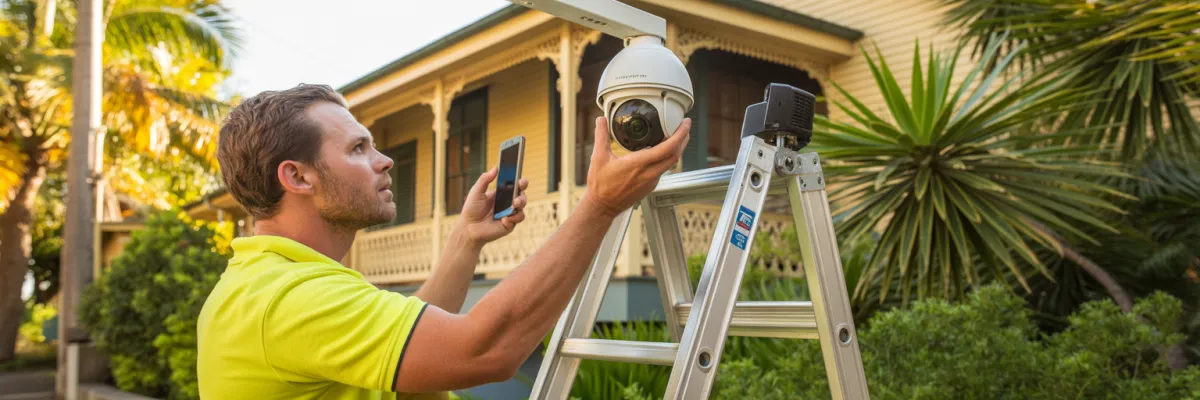
Before permanent mounting, have someone hold the camera while you walk every approach path. Watch yourself on the phone's live view. Can you see your face clearly? At what distance do you enter frame? Any blind spots? This 15-minute test catches 90% of angle problems.
Quarterly Maintenance
Every three months: check camera angles, trim vegetation blocking views, verify mounts haven't shifted. After storms, ensure cameras still point correctly—wind can shift angles by several degrees.
DIY vs Professional Installation
DIY works for: Small properties, 2-3 cameras, homeowners with time to learn and test thoroughly.
Call professionals when:
Large properties needing 10+ cameras
Complex layouts with multiple blind spots
Post-break-in upgrades requiring strategic placement
You value guaranteed peace of mind
Get Your Home Protection Right the First Time
Home security camera angle optimization isn't complicated—but getting it wrong costs Brisbane families thousands in stolen property and sleepless nights.
You've learned:
The 15-30 degree angle rule for optimal facial recognition
Mount heights of 2.5-3 meters work best
Five critical zones every home needs covered
Common mistakes that create blind spots
Brisbane-specific challenges like sun glare and storm runoff
But knowing and doing are different things. If you're unsure your cameras are positioned correctly, get a professional assessment.
Call +61409809577 / 0409809577
Your family's safety is worth getting this right the first time.