Home CCTV Regulations Australia 2026: Complete Guide
You've finally decided to install security cameras to protect your family and home. Smart move. But before you call an installer or start drilling holes, there's this nagging question keeping you up at night: Am I even allowed to point cameras at my driveway? What about the footpath out front? And if your neighbor can see your camera pointed near their fence, are they gonna complain? Maybe even call the cops on you?
Here's what's really scary—you don't wanna spend thousands on a proper security system, get everything installed and working perfectly, only to have some council officer or angry neighbor force you to rip it all down because you didn't know the rules.
I get it. The legal side of home security feels overwhelming. Every Facebook group has different advice. One mate says "just install them anywhere, it's your property." Another reckons you need council approval for everything. Your neighbor mentioned something about privacy laws. And Google just makes it worse with conflicting information from every state.
Here's the thing that'll help you sleep better tonight: Installing home security cameras in Australia is completely legal. Full stop. You have every right to protect your property. But—and this is the part that matters—there ARE some rules you gotta follow around privacy, recording, and where you point those cameras.
This guide breaks down everything Brisbane homeowners need to understand about home CCTV regulations in 2025. By the end of this article, you'll know exactly how to install security cameras that protect your family and keep you completely compliant with Australian law.
Is It Legal to Have Security Cameras on Your House in Australia?
Yes, it's completely legal to install security cameras on your residential property in Australia. You don't need council approval in most cases. You don't need your neighbor's permission. And you definitely don't need some government agency signing off on your decision to protect your family.
Homeowners across Brisbane—and all of Australia—have the right to install CCTV systems for security purposes without jumping through bureaucratic hoops. But legal doesn't mean "anything goes." You've still gotta comply with Australian privacy laws.
What You CAN Record:
Your own property—every square meter of it
Your driveway, front yard, and back yard
Public areas that are visible from your property (streets, footpaths)
Entry points like doors, gates, and garages
What You MUST Do:
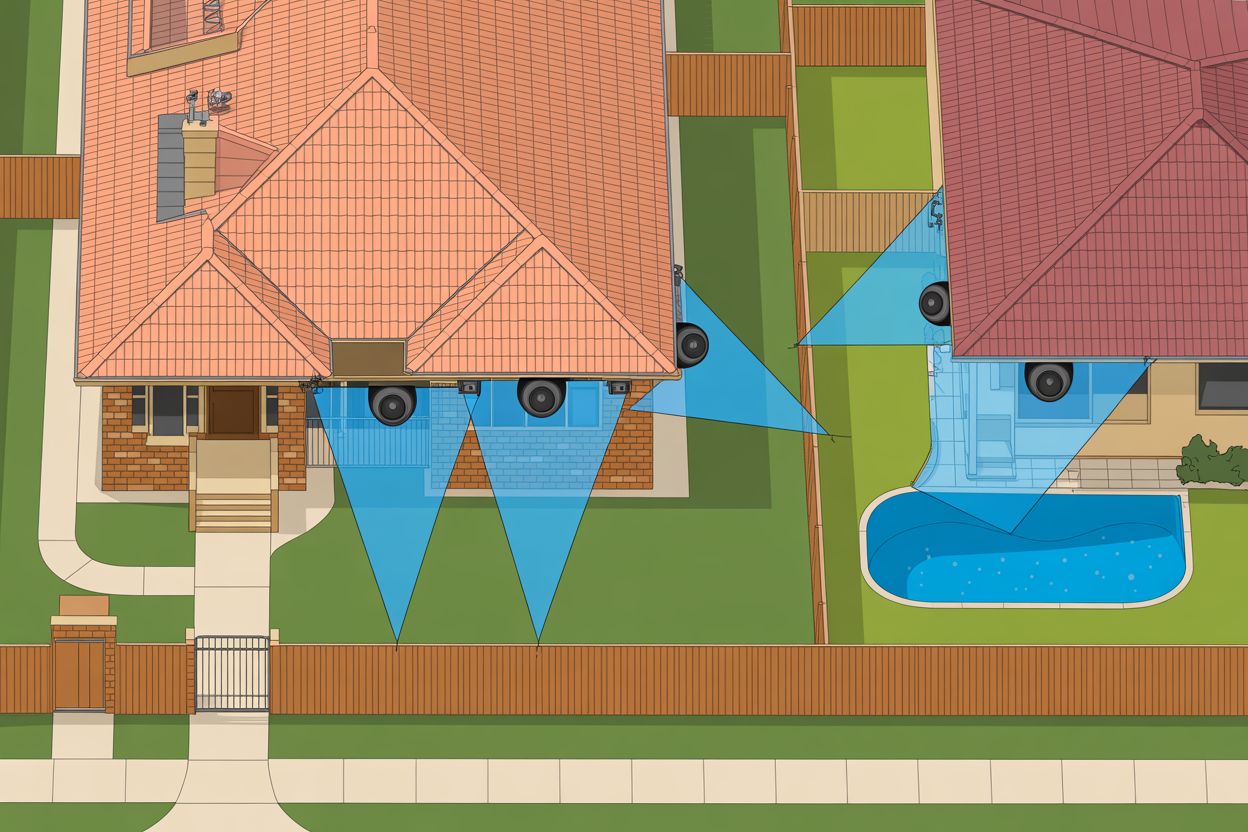
Position cameras to minimize recording your neighbor's private areas
Use cameras for legitimate security purposes—not to harass or spy
Avoid pointing cameras directly into areas where people have reasonable privacy expectations
The Audio Recording Thing: Audio recording has way stricter rules than video in most states. In Queensland, you need all-party consent to record audio—which basically means everyone being recorded needs to agree. That's why most Brisbane homeowners just disable audio on their cameras completely. Video gives you everything you need for security anyway.
Signage Requirements: Recommended? Yes. Legally required for your home? Generally no, not in most Australian states for residential properties. But it's still smart to put up a sign or two—it deters criminals and shows you're being transparent.
As long as your security cameras respect reasonable privacy expectations and aren't being used for creepy voyeuristic purposes, residential CCTV installation is completely lawful across all Australian states and territories.

Understanding Australian Privacy Laws for Home CCTV
The Privacy Act 1988 and Home Security Cameras
Here's the bit that'll make you breathe easier: The Privacy Act 1988 doesn't actually apply to your home security cameras. The federal Privacy Act covers businesses, government agencies, and organizations. But residential security cameras used for personal or household security? They're exempt from the Act's requirements.
This is what the Office of the Australian Information Commissioner calls the "personal or domestic purposes" exemption. If you're installing cameras to protect your home and family—not running a business surveillance operation—you don't need to register your CCTV system, comply with the Australian Privacy Principles, or create privacy policies.
That said, just because the Privacy Act doesn't apply doesn't mean you can point cameras anywhere you want. State and territory laws still govern how you use those cameras, particularly around surveillance and invasion of privacy.
What "Reasonable Expectation of Privacy" Means
The "reasonable expectation of privacy" test asks one simple question: Would an ordinary person in this situation expect their activities to be private?
Someone in their enclosed backyard, sunbaking in their bikini? Yeah, they've got a reasonable expectation of privacy there. Someone walking down the street in full view of a hundred houses? Nope, no expectation of privacy.
Practical Examples:
✅ Totally Legal:
Recording your own driveway, even if it captures part of the street
Pointing a camera at your front door that includes the footpath in the background
Covering your side gate and access points
❌ Definitely Illegal:
Deliberately pointing cameras through your neighbor's bathroom window
Zooming in to record your neighbor's enclosed backyard pool area
Positioning cameras specifically to watch your neighbor's private activities
The difference between legal and illegal often comes down to intent. Are you trying to protect your property, or are you trying to watch what your neighbor's doing? Courts can tell the difference.
Recording Laws: Video and Audio Restrictions
Video Recording Regulations
Here's the good news: Video recording has pretty relaxed rules. You're allowed to record video of any area that's visible from your property—including streets, footpaths, and neighbors' properties visible from your vantage point—provided your primary purpose is security and you're not intentionally targeting private areas.
If your driveway camera naturally captures part of your neighbor's front yard because it's in the frame—that's fine. It's incidental footage. But if you deliberately angle and zoom your camera to watch your neighbor's backyard activities? That's illegal surveillance.
The legal test is about primary purpose. Your primary purpose needs to be security for your property. Incidental footage of public areas or visible neighboring properties is fine. Targeted surveillance of private areas is not.
Audio Recording Restrictions and Consent Requirements
Let me be blunt: Most Brisbane homeowners should disable audio recording on their security cameras completely.
Queensland's Audio Recording Laws: Queensland requires all-party consent for recording private conversations. Recording private conversations without all-party consent can result in serious penalties including imprisonment.
Even in one-party consent states, recording audio on home security cameras creates legal risks. You're often not a participant in the conversations being recorded, which means you don't meet consent requirements.
Neighbor Rights and Boundary Considerations
Can Your Neighbor Complain About Your Security Cameras?
Short answer: Yes, they can complain. Anyone can complain about anything. Better question: Do they have legal grounds to force you to remove or relocate your cameras?
That depends entirely on where your cameras are pointed and what they're recording.
When Your Neighbor Has NO Legal Grounds:
Your camera covers your own driveway
Your camera records your front door and incidentally captures part of the street
They simply don't like cameras
When Your Neighbor DOES Have Legal Grounds:
Your camera is pointed directly at their bedroom or bathroom windows
Your camera deliberately records their enclosed backyard
You're recording audio of their conversations
Most neighbor complaints about security cameras come down to misunderstanding. Your neighbor sees a camera near the fence and assumes it's pointed at their yard. Often, just having a conversation fixes everything: "Hey mate, just wanted to let you know we're installing cameras after that break-in down the street. They're covering our driveway and entry points, not your place."
Shared Property Boundaries and Fence Lines
Boundary fences aren't private spaces with privacy expectations. Your camera covering your side of the fence to monitor access points is completely legitimate. What matters is beyond the fence—are you recording into your neighbor's enclosed yard, or are you just capturing the fence itself and your side of the boundary?
Council Regulations and Permit Requirements
Do You Need Council Approval for Residential CCTV?
In almost all cases, Brisbane homeowners do NOT need council approval to install security cameras on their residential property. Security cameras are considered "exempt development" under Queensland planning regulations. You can install them without lodging a development application or waiting for approval.
The Exceptions—When You Might Need Approval:
Installing large poles or structures specifically for cameras
You're in a heritage zone or character home area
Major electrical work requiring permits (for the electrical work itself, not the cameras)
Heritage Properties and Character Home Restrictions
If your property is in a heritage zone or designated character area (Paddington, New Farm, Clayfield, Red Hill, etc.), you've got additional restrictions on what you can do to the exterior of your home.
Before installing front-facing cameras on heritage properties, call Brisbane City Council's heritage advisory service. They'll explain whether you need approval and what positioning would be acceptable. Often, small discrete cameras mounted under eaves in neutral colors don't require approval—because they're barely visible and don't affect the character of the home.
Body Corporate and Strata Requirements
If you live in a unit, apartment, or townhouse with a body corporate, their bylaws control what you can install. Review your body corporate rules before installing any cameras, as you'll likely need committee approval for external cameras. This process can take time, so plan ahead.
What You Can and Cannot Record with CCTV
Recording Your Neighbor's Property Incidentally
Incidental recording of neighboring property is fine. The key word is incidental. You're not pointing the camera at their property—you're pointing it at yours. Their property just happens to be visible in the background.
What "Incidental" Actually Means:
✅ Incidental (Legal):
Your driveway camera's primary focus is your driveway, but the edge includes your neighbor's mailbox
Your front door camera shows your porch, with your neighbor's front yard visible in background
❌ NOT Incidental (Illegal):
You angle your camera specifically to capture your neighbor's driveway instead of yours
You position a camera that serves no security purpose for your property but records theirs
Filming Public Streets and Footpaths
You can record the street in front of your house completely legally. Public streets and footpaths are public spaces. People in public view have no reasonable expectation of privacy.
This footage can be incredibly valuable for capturing package thieves, hit-and-run accidents, suspicious activity, or neighborhood incidents happening on the street.
Recording Children and Minors
Your own children in your own home = no privacy law issues. Recording them in the pool, checking they got home safely, monitoring teenagers—all legitimate parenting uses.
When your kid has friends over, those children will also be recorded. Generally this is fine—they're on your property, and you're responsible for their safety. The line you can't cross: Recording children in circumstances where there's sexual or inappropriate overtones.
Using CCTV Footage as Evidence
Providing Footage to Police
When you've been the victim of a crime and your cameras captured evidence, police will ask if you can provide footage. You're not legally required to provide footage without a warrant, but if you've been victimized, providing evidence makes sense.
The process is straightforward: Review your footage to find the relevant timeframe, export the specific clips showing the incident, and provide them to police via USB drive or email. Include date/time stamps, your camera location description, and brief written explanation of what the footage shows.
Admissibility of CCTV Evidence in Court
Australian courts regularly accept CCTV footage as evidence, but it needs to meet certain standards:
What Makes Footage Admissible:
✅ Proper chain of custody documented
✅ Legally obtained (cameras positioned lawfully)
✅ Authentic and unaltered
✅ Relevant to the case
✅ Date/time stamps are accurate
If your footage includes illegally recorded audio, that audio portion will likely be excluded from evidence—another reason to just disable audio entirely.
Compliance Best Practices for Brisbane Homeowners
Pre-Installation Checklist
Before calling an installer, plan your camera positions on paper. For each location, ask yourself: What am I trying to protect? What will this camera see? Can I achieve the same protection without capturing neighbor's private areas?
Check for heritage restrictions if you're in designated areas. Review body corporate rules if applicable. Consider having a quick conversation with neighbors about your plans—it can prevent problems before they start.
During Installation Best Practices
Review camera angles as they're installed. Ask to see the live view and check what's actually in frame. Request adjustments before installation is complete. Confirm audio is disabled on all cameras and verify it yourself.
Post-Installation Compliance Steps
Change all default passwords immediately. Set up your retention period. Enable two-factor authentication if available. Put up signage even though it's not legally required. Test everything thoroughly during the first week.
Create a simple document recording your installation date, purpose, camera positions, audio disabled confirmation, and retention period. This documentation helps if questions ever arise.
Ongoing Maintenance
Check monthly that all cameras are still working. Update firmware quarterly. Review camera angles after any changes to your property or neighbor's property. Conduct an annual system health check.
If you discover any non-compliance issues, fix them immediately. Disable audio if you find it's been recording. Adjust camera angles that invade privacy. Document what you fixed and when.
Protecting Your Brisbane Home the Right Way
Installing security cameras to protect your Brisbane home and family is completely legal and achievable—you just need to do it right.
The Core Principles:
Focus on your property, not your neighbors
Turn off audio recording
Use cameras for security, not surveillance
Be transparent with signage
Keep footage secure and use it responsibly
Follow these principles and you'll be compliant with Australian CCTV regulations while effectively protecting your home.
Your Next Steps:
If you haven't installed cameras yet, plan your camera positions, decide between DIY and professional installation, and get quotes from reputable licensed installers who demonstrate compliance knowledge.
If you already have cameras, review your setup against this guide. Fix any compliance issues immediately—disable audio today, adjust invasive camera angles, change weak passwords, add signage if needed.
You have every right to install security cameras on your Brisbane property. The regulations exist to balance your right to protect your family with other people's right to reasonable privacy. As long as you respect that balance, you're going to be completely fine.
Thousands of Brisbane families have security cameras operating legally and effectively right now. They're sleeping better knowing they can check if their kids got home safely, package thieves will be caught on camera, and their property is protected while they're at work or on holiday.
You can have that same peace of mind. Take action today—book a free security assessment with a licensed Brisbane installer, understand your options, and make the decision to invest in real security for your family.
Protect what matters most. Do it legally. Do it right. Do it now.
Your Brisbane home and family deserve nothing less.