Home Camera Placement Mistakes to Avoid in 2026 | Brisbane
You've invested thousands in a professional security camera system for your Brisbane home. The cameras are crystal clear, the app works perfectly, and the installer did a great job. But there's a problem: the cameras are in the wrong places. Your front door is covered, but the angle can't capture faces. Your driveway camera misses license plates. And that expensive 4K camera watching your pool? It's capturing nothing but reflections on the glass doors.
I've seen this play out dozens of times. A family had six cameras installed, but every piece of footage was worthless after a break-in. The police couldn't identify anyone because all the cameras were mounted too high, capturing the tops of heads instead of faces.
Camera placement mistakes are the #1 reason Brisbane homeowners end up with security systems that don't actually secure anything. After installing thousands of residential camera systems across Brisbane's suburbs, we've seen the same costly mistakes repeated in home after home.
Mistake #1: Mounting Your Cameras Too High to Capture Faces
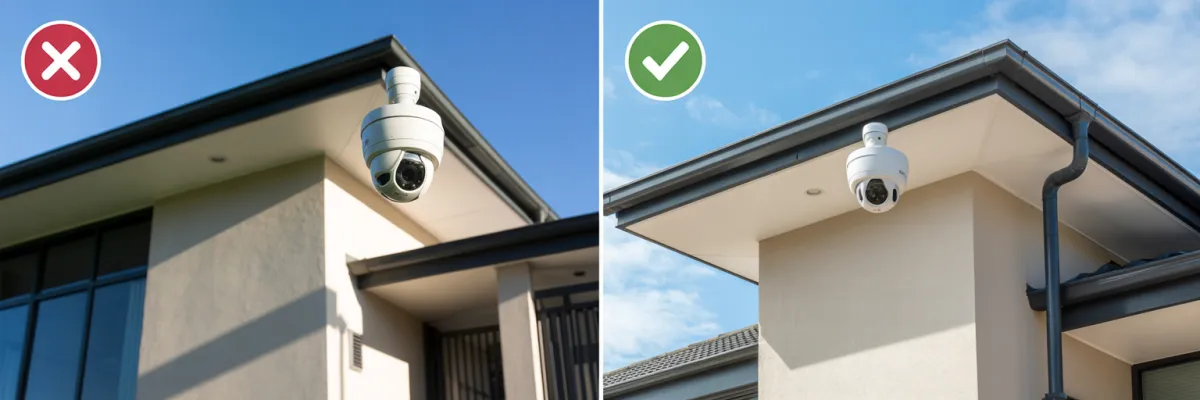
Here's the thing about camera placement: higher doesn't mean better. I've walked into Brisbane homes and seen cameras mounted 12, 14, even 15 feet up on the wall. The homeowner thinks they've outsmarted potential vandals and gotten this amazing bird's eye view.
Then I ask them to show me a face in their footage. Any face. That's when it hits them: all they're capturing is the tops of people's heads.
When someone breaks into a garage and they hand footage to Queensland Police, the detective is blunt: "I can tell you this person had dark hair and wore a hoodie. That's it." If those cameras had been mounted at 8 feet instead of 12, police would've had clear facial shots.
Why This Happens
Installers mount cameras as high as possible worried about vandalism. But would you rather have a camera that might get vandalized but captures usable footage 99% of the time? Or a camera that's vandal-proof but never captures a face police can use?
In residential Brisbane suburbs, camera vandalism is rare. Most criminals just want to grab stuff and leave.
How to Fix It
The sweet spot is 7-9 feet high:
For doorways and entry points, mount at 7-8 feet with a 15-25 degree downward angle. This captures faces of people between 5'2" and 6'4" clearly.
For driveways, go slightly higher—8-9 feet—because you're capturing people further away and need that elevated angle to see over vehicles.
For pathways and side access, stick to 7-8 feet. These areas are tight, and you need clear facial shots.
The moderate downward tilt gives you the most natural, identifiable view of someone's face as they approach.

Mistake #2: Creating Unusable Night Footage with Glass Reflections
Those gorgeous floor-to-ceiling glass doors that open onto your backyard? They're beautiful. They're also an absolute nightmare for security cameras.
Someone's mounted a camera inside, pointing through the glass to monitor their backyard or pool area. During the day, the footage looks fantastic. Then night falls. And their camera turns into an expensive paperweight—just a big white glow on playback.
The Glass Reflection Problem
Security cameras use infrared (IR) LEDs to see in the dark. When you point a camera through glass, those IR LEDs bounce right back off the window. The camera films its own infrared light reflecting on the glass instead of what's beyond it.
During the day this isn't a problem. But the second it gets dark enough for night vision to kick in, your footage becomes useless. And most break-ins happen at night.
Three Solutions That Work
Option 1: Mount the camera outside under an eave - This is the best solution. Position your camera outside but under your roofline's protection. Proper outdoor-rated cameras (IP66 or IP67) are built for Brisbane's climate.
Option 2: Turn off IR and use external lighting - If you must mount inside, turn off the camera's IR LEDs and use motion-activated lights outside instead. The downside: if lighting fails, you've got no night vision.
Option 3: Use a window-mounting camera - Some cameras sit flush against window glass with IR LEDs positioned to minimize reflection. They're not as good as outdoor mounting, but better than standard cameras through glass.
For Brisbane homes, I recommend Option 1 about 95% of the time.
Mistake #3: Leaving Side Gates Unmonitored (The #1 Brisbane Break-In Entry Point)
Walk around any Brisbane suburb and you'll notice something consistent: side access. That narrow pathway running along the side of the house from the front fence to the backyard. It's in probably 80% of Brisbane homes.
And burglars absolutely love them.
Experienced criminals don't bother with the front door. They jump your side fence, walk down that convenient pathway, and access your backyard completely hidden from view. Meanwhile, you've got a camera pointing at your front door capturing nothing.
Why Burglars Love Side Gates
Think about your side gate from a criminal's perspective:
Hidden from street view
Not visible to neighbors
Often poorly lit or dark at night
Rarely monitored by cameras
Direct access to backyards where valuables are stored
Your Solution
Mount a camera on your house wall looking down the pathway from above. Position it high enough (8-9 feet) that someone can't easily reach it, angled to capture the full length from gate to backyard.
Make the camera visible. You want people to see it before they jump that fence. Half the value is deterrence.
Use a wide-angle lens (2.8mm or 3.6mm) because these pathways are usually narrow. Add motion-activated lighting if possible.
The side gate camera is probably the single most cost-effective camera you can install. Yet it's the one camera most homeowners forget.
Mistake #4: Ignoring the Driveway and Missing License Plate Captures
Your driveway's probably where you park thousands of dollars worth of vehicles every night. And most Brisbane homeowners have no camera coverage of it, or a camera positioned so badly it can't capture license plates.
Someone's car gets broken into, tools stolen, or the car gets damaged. The homeowner has footage of someone walking around their vehicle. But can they identify the person? No. Can they read the license plate of the car they drove up in? Also no.
License Plate Capture Requires Specific Setup
Most people think any camera pointed at the driveway will capture plates. Wrong. License plate capture is surprisingly difficult because plates are small, reflective, and usually moving.
A Queensland license plate is roughly 370mm x 130mm. Your standard wide-angle security camera can't capture plates—they're trying to cover too much area. The plate ends up being maybe 20-30 pixels in the image, not nearly enough resolution to read clearly.
Police need to read every character on that plate clearly. If even one letter or number is fuzzy, they can't use it.
The Distance Rule for Plate Capture
Position your camera 20-25 feet from where vehicles will be when you want to capture their plates. This is the sweet spot where a 4K camera with a narrow lens can capture plates clearly.
Use a dedicated camera with a narrow-angle lens (6mm-12mm focal length)—not your wide-angle camera covering the whole front yard.
Angle the camera perpendicular to the direction of traffic. You're trying to minimize the angle between the camera and the plate.
This often means you need two driveway cameras: one wide-angle for general coverage, and one narrow-angle dedicated purely to capturing plates.
Mistake #5: Overlooking Backyard Blind Spots (Tools, Bikes, and Equipment Theft)
Most Brisbane homeowners install cameras covering the front of the house, maybe the driveway, the main entry points. But they completely forget about what's actually sitting in their backyard worth stealing: bikes, tools, outdoor furniture, BBQs, kids' play equipment.
Someone jumps the back fence and cleans out the entire shed. The family has cameras covering the back patio area. But the shed is in the back corner of the yard, completely out of range of all cameras.
What Gets Stolen from Brisbane Backyards
Backyards are where we keep valuable stuff. Bikes cost thousands. Tools and equipment sit in sheds. Outdoor furniture and BBQs get stolen constantly. Kids' equipment, sporting goods, garden equipment—most Brisbane backyards have thousands worth of stealable items just sitting there.
Coverage Strategy for Large Properties
Map your valuable storage areas first. Where's your shed? Where do bikes get stored? Those are your priority coverage zones.
Position cameras to cover approaches to those areas, not just the areas themselves. You want footage of someone walking toward your shed.
Create coverage overlap. If you've got a 30-meter deep yard, you probably need 2-3 cameras providing overlapping coverage.
Consider mounting a camera on your back fence pointing back toward the house. This captures people coming over the fence before they reach your stuff.
Cover the areas where your actual valuables are, not just where you think break-ins happen.

Mistake #6: Installing Cameras Without Considering Night Vision Requirements
When do most break-ins happen in Brisbane? Between 8pm and 6am when it's dark outside. According to Queensland Police statistics, roughly 60% of residential break-ins occur during nighttime hours.
So here's what blows my mind: people spend thousands on security cameras and never check how they perform at night. They see crisp daytime images and assume it'll be the same after dark. Then someone breaks into their shed and the footage is basically just darkness with vague shadows.
Why Night Vision Quality Matters More Than Resolution
Everyone gets caught up in resolution specs. But here's what matters more: if your camera can't capture usable footage at night, the resolution is irrelevant.
A 4K camera with poor night vision is worse than a 2K camera with excellent night vision. Most crimes happen when it's dark. Your camera needs to work when it's dark.
Understanding IR Illumination Distance
Cameras advertised as "30m night vision" or "40m IR distance" are measured under ideal conditions that don't exist in real life. In Brisbane backyards with ambient street lighting, humidity, and occasional rain—you're getting maybe 60-70% of that advertised distance.
IR night vision gets progressively worse the further out you go. For facial recognition, keep it within 8-10 meters at night. For license plates, 15-20 meters maximum.
Supplemental Lighting Options
Motion-activated LED lights are probably the best solution for most Brisbane homes. When someone walks into the camera's coverage area, the light kicks on, giving better illumination and scaring whoever triggered it.
Always-on dusk-to-dawn lights provide consistent illumination all night. Better for areas where you want continuous monitoring.
I recommend motion-activated LED lights in key areas (side gates, back pathways, shed approaches) combined with cameras that have solid IR performance.
Mistake #7: Accidentally Breaking Privacy Laws with Poor Camera Angles
Nobody sets out to be the creepy neighbor with cameras pointed at other people's properties. But it happens more often than you'd think. You're trying to cover your driveway or backyard, and accidentally your camera's also capturing half of next door's yard, their windows, maybe their pool area.
Then you get the knock on your door. Your neighbor's not happy. Now you've got an awkward situation and possibly a legal problem.
What Australian Privacy Law Says
The Office of the Australian Information Commissioner (OAIC) has specific guidelines:
You CAN record:
Your own property boundaries
Public spaces like streets, footpaths (incidental capture is fine)
Shared driveways with neighbor awareness
You CANNOT record:
Neighbor's private areas with reasonable expectation of privacy
Areas where your camera's primary purpose is monitoring someone else's property
Even if you're monitoring your own property, if it's also capturing significant footage of your neighbor's private areas, that's still a privacy violation.
Mistake #8: Choosing Cameras Based on Price Instead of Purpose
I've walked into Brisbane homes where someone bought a 4-pack or 8-pack camera system—all the same cameras, all the same specs—and tried to use them for everything. Front door, driveway, backyard, side gate.
Then they're confused why the driveway camera can't read license plates. Or why the front door camera doesn't capture faces clearly. It's like buying a toolbox full of hammers and wondering why you can't tighten screws.
Why One Camera Type Doesn't Work for All Locations
Different locations have different needs:
Front door: Close-up facial recognition, two-way audio, narrow field of view.
Driveway: License plate capture, wider coverage, higher resolution for detail at distance.
Side gate: Motion detection, wide angle to cover narrow pathways, decent IR range.
Backyard: Broad coverage, good IR distance to reach sheds, weatherproofing.
Using the same camera for everything means you're compromising everywhere.
Resolution Requirements Vary by Purpose
You don't need 4K cameras everywhere. Use 4K where identification matters (doors, entries, plate capture) and 2K everywhere else. You'll save money on equipment and storage.
Mistake #9: Neglecting Regular Camera Maintenance (Brisbane Weather Takes a Toll)
People treat cameras like set-and-forget devices that'll keep working forever with zero attention. Then when they need footage, they discover half their cameras aren't recording. Lenses are covered in grime and spider webs. Connections have corroded from humidity.
Brisbane's subtropical climate is brutal on electronics. Intense UV exposure, humidity year-round, summer storms, and temperature swings—it's hard on equipment.
Brisbane's Humidity Destroys Camera Connections
The biggest killer of security cameras in Brisbane isn't vandalism—it's humidity. That constant moisture gets into cable connections, power supplies, junction boxes, camera housings. Even IP66 or IP67 "weatherproof" cameras can develop issues if installation wasn't perfect or if seals degrade.
Moisture causes corrosion on metal contacts. Eventually the connection fails completely or becomes so unreliable that cameras drop offline randomly.
The fix: check connections regularly. Look for corrosion, moisture inside junction boxes, degraded cable boots.
Spider Webs and Insects
Spiders absolutely love security cameras. The housing provides shelter, IR LEDs attract insects at night, and it's warm. So they build webs right across your camera lens.
This is particularly bad in Brisbane because we've got spiders year-round. You won't notice unless you check your footage. The system shows cameras as "online" but the footage quality has degraded so much from cobwebs that facial recognition is impossible.
Clean your cameras at minimum twice yearly.
UV Damage to Camera Housings
Brisbane gets hammered with UV radiation. Over time, UV breaks down plastic housings, makes rubber seals brittle, degrades cable insulation.
Cheaper cameras often use lower-grade plastics that aren't UV-stabilized. They might be "outdoor rated" but not rated for Queensland's UV levels.
Best positioning: mount cameras under eaves or in shaded areas. North-facing walls get the most sun exposure in Brisbane.
Regular maintenance prevents cameras from failing when you need them most. Check footage quality, clean lenses, inspect connections, and test motion detection regularly to keep your system working properly.
Mistake #10: Not Testing Camera Angles Before Final Installation
Here's how most camera installations go: installer shows up, walks around, points at spots on the walls, mounts the cameras, runs all the cables. Job done.
Then a week later, the homeowner's watching the footage and realizes this isn't right. The front door camera's aimed too high. The driveway camera can't see where cars actually park. The backyard camera has a tree branch blocking half the view.
Now they're stuck. Cameras are permanently mounted. Holes are drilled. Cables are run through walls. Moving them means new holes, patching old holes, running new cables.
The "Looks Good" Assumption
During installation planning, you're standing in your driveway with the installer. He points at a spot and says "we'll put a camera right there." You visualize where the camera will point and think "yeah, that should work."
But you're not seeing what the camera will see. You're imagining it. And humans are terrible at accurately imagining camera field-of-view and coverage.
A camera lens doesn't see like your eyes. What looks like "this camera will definitely see the whole driveway" often turns out to be "this camera sees half the driveway" when you review actual footage.
Walk-Test Before Finalizing
Before the installer drills a single hole, have them set up each camera temporarily. Hold it in position, power it on, show you the actual view on your phone.
Then you walk the coverage area. Walk up to your front door while watching the camera feed. Does it capture your face clearly? For driveway cameras, park your car in different positions and check if license plates are readable.
This takes maybe 10-15 minutes per camera. But it reveals problems immediately while they're still easy to fix.
The simple rule: never let an installer permanently mount a camera until you've seen the actual footage from that position and confirmed it covers what you need.

Don't Let Poor Camera Placement Leave Your Brisbane Home Vulnerable
Proper security camera placement transforms your investment from expensive decoration into genuine family protection. The 10 mistakes we've covered—from mounting heights to glass reflections, blind spots to privacy violations, equipment selection to maintenance neglect—are all easily avoided with proper planning.
But here's the reality: most of these mistakes aren't obvious until something happens. You won't know your front door camera's mounted too high until you need to identify someone and can't. You won't realize your glass door reflection issue until you review nighttime footage. You won't discover your side gate blind spot until that's exactly where criminals enter.
Brisbane's unique climate, suburban architecture, and crime patterns require local expertise. Our subtropical weather destroys cheap installations. Our home designs create vulnerabilities that criminals know how to exploit.
Whether you choose to implement these recommendations yourself or schedule a professional assessment, addressing camera placement mistakes needs to happen before an incident occurs. Because discovering your cameras won't deliver when you actually need them—that's the worst possible time to learn these lessons.
Don't wait until you need footage to discover your cameras won't deliver.
Ready to fix your camera placement mistakes? Get your free Brisbane home security assessment and find out if your cameras are actually protecting your family—or just recording footage you'll never be able to use. Call us: +61409809577.