Battery vs Wired Camera Installation: Which Saves More Money?
Sarah had the same question you do right now. After a car was broken into two streets away, she spent several evenings comparing battery and wired security cameras online — and nearly chose the wrong system because of one thing nobody mentions upfront.
She nearly pulled the trigger on a set of Arlo cameras from Bunnings. They looked affordable and the setup seemed easy. What she didn't see at first? The cloud subscription. The battery replacement cycle. The fact that her cameras would drop during Brisbane's summer storms — exactly when she'd need them most.
If you're a Brisbane homeowner trying to decide between battery vs wired camera installation, you've probably noticed something frustrating: the upfront price tells you almost nothing about what you'll actually spend over time.
In this guide, we break down what really separates these two systems — how they work, how they perform in Queensland conditions, and which type of Brisbane home each one actually suits.
Are Battery or Wired Security Cameras Better?
Neither system is universally better — the right choice depends on your home layout, ownership situation, and how much ongoing hassle you're willing to manage. Here's a quick breakdown:
Battery cameras are better if you:
Rent or want a no-drill installation
Need cameras in locations without nearby power access
Want a faster, simpler setup as a starting point
Wired cameras are better if you:
Own your home and want a permanent solution
Prefer no ongoing subscription or battery maintenance
Need reliable, uninterrupted footage during Brisbane storm season
Want consistent resolution and night vision performance
For most Brisbane homeowners weighing long-term value, wired systems typically deliver a lower total cost of ownership over time — despite the higher upfront installation investment.
What's the Real Difference Between Battery and Wired Security Cameras?
Most people go into this decision thinking it's just about cables versus no cables. It's actually a lot more than that — the way each system works changes what you get, how reliable your coverage is, and what you'll be dealing with a year from now.
How Battery-Powered Cameras Work
Battery cameras run on rechargeable or replaceable lithium batteries and connect to your home's WiFi network. There's no cabling involved, which makes them easy to mount just about anywhere — on a fence post, under an eave, above a garage door.
Here's the catch though — most battery cameras are motion-activated, not continuously recording. That's by design. Continuous recording would drain the battery within days. So the camera sits in standby mode and wakes up when it detects movement. In practice, this creates gaps. A slow-moving person might not trigger the sensor fast enough, or the camera wakes up just in time to capture the back of someone walking away.
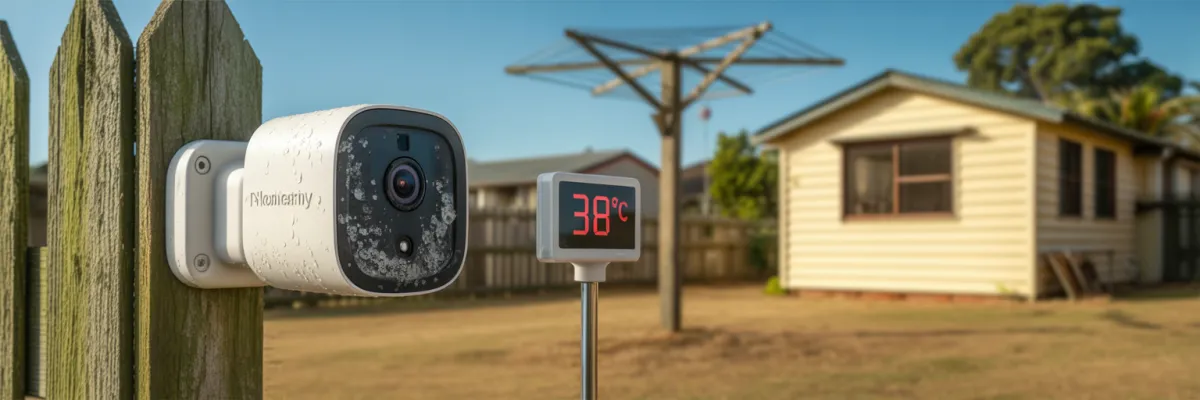
There's also a Queensland-specific problem: lithium batteries don't like heat. During Brisbane's warmer months, battery performance takes a real hit. You'll find yourself recharging or replacing more frequently than the product specs suggest.
How Wired Camera Systems Work
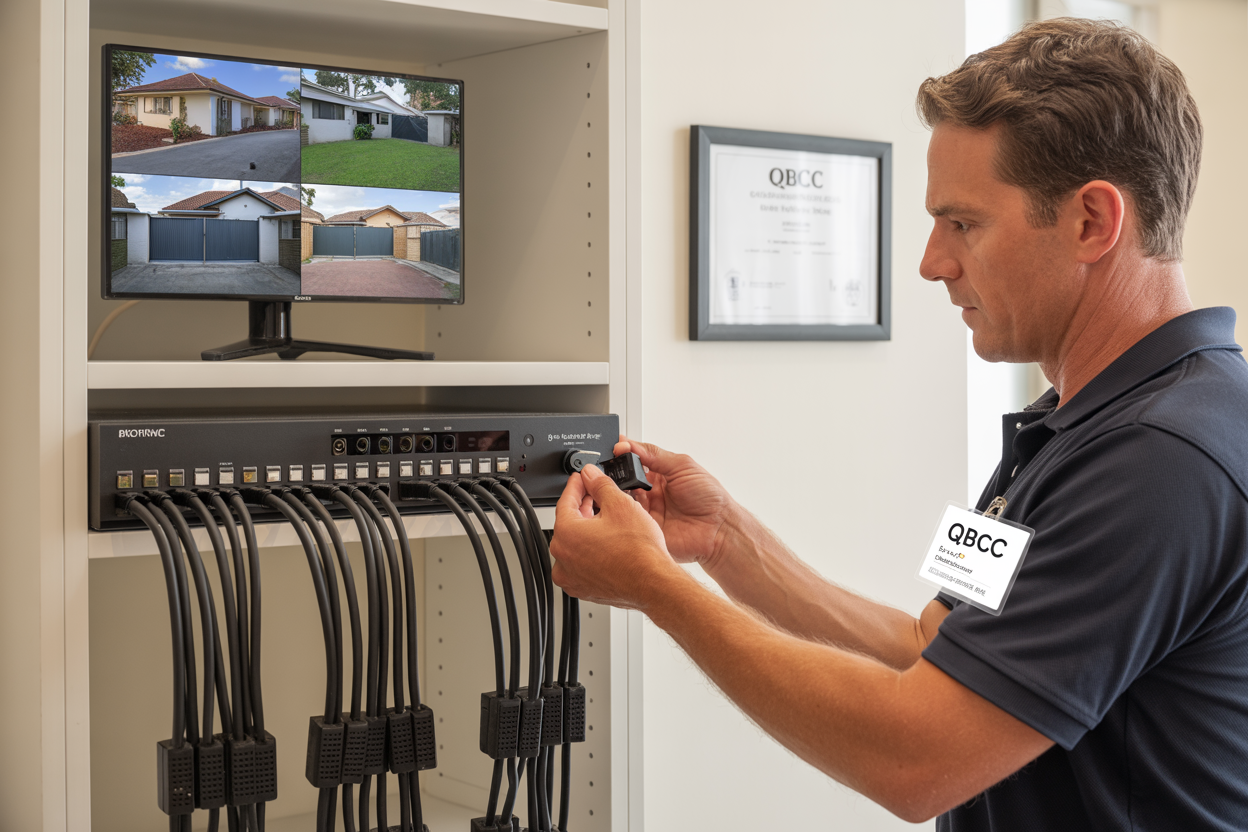
Wired systems connect your cameras to a central recording unit — either an NVR (Network Video Recorder) for IP cameras over ethernet, or a DVR for older coaxial setups. Each camera runs a cable back to a box that stores footage locally on a hard drive in your home.
Power over Ethernet (PoE) is the most common modern setup. A single cable carries both power and data to each camera. Your installer routes cables through your roof cavity or walls, connects everything to the NVR, and sets up remote viewing on your phone.
Because everything records locally, there's no cloud subscription and no dependency on your internet connection. If your NBN drops during a Brisbane storm — which it does — your wired system keeps recording. Battery cameras go dark.
Performance — What Queensland Conditions Do to Each System
This is where the comparison gets genuinely interesting for Brisbane homeowners. It's not just about which system records footage — it's about whether that footage is actually there when you need it.
Video Quality and Night Vision
Wired IP cameras record at 4K or 1080p continuously. There's no trade-off between quality and power consumption — what you set is what you get, every hour of every day.
Battery cameras are different. To preserve battery life, many models automatically reduce resolution during longer recording sessions or when the battery drops. You might configure a higher resolution but find it recording at lower quality during a busy afternoon when the motion sensor keeps triggering.
Night vision follows the same pattern. Wired cameras deliver clear footage at significantly greater distances. Battery cameras manage a shorter range before quality degrades — and on a larger Brisbane block with a long driveway or side passage, that gap matters.
Queensland Police Service recommends a minimum of 1080p resolution for CCTV footage to be usable in an investigation. Make sure your system meets that consistently — not just under ideal conditions.
Reliability During Brisbane's Storm Season
This is where wired systems earn their higher upfront investment more than anywhere else.
Battery cameras rely on your WiFi to transmit footage to the cloud. During Brisbane's storm season — anyone who's lived through a wet season knows what that means — WiFi dropouts are common. When your internet goes down, battery cameras stop recording. There's no local backup. That gap is permanent.
Wired systems with a local NVR keep recording regardless of your internet connection. Storm, power fluctuation, NBN outage — none of it interrupts local recording.
Heat is the other factor. Lithium batteries degrade faster in high temperatures, and Brisbane sits well above comfortable operating range for a good portion of the year. Expect more frequent maintenance during summer — right when opportunistic property crime typically increases.
On weatherproofing: look for IP66 or IP67 ratings. IP66 covers dust and powerful water jets. IP67 adds short-term submersion protection. Both suit Queensland — but IP67 is worth prioritising for cameras directly exposed to storm-driven rain.
Remote Viewing and App Experience
Both systems let you check your cameras from your iPhone at work, at school pickup, or while you're away. The difference is reliability. Battery systems depend on cloud server uptime — and outages do occur. Major brands have all experienced disruptions that left customers without remote access at the worst possible moments.
Wired systems offer local plus remote redundancy. Even if the remote connection drops, footage is still recording locally. You're not relying on an overseas server to keep your Brisbane home monitored.
Which Brisbane Homes Are Best Suited to Each System?
Understanding performance is one thing. Knowing which system suits your actual property is where the decision gets practical.
When Battery Cameras Make Sense
There are genuinely good reasons to choose battery cameras, and it'd be a disservice to pretend otherwise.
If you're renting, battery cameras are often your only practical option. Most landlords won't approve drilling through walls or running cables through the roof cavity — and battery cameras give you meaningful coverage without that. When you move, you take them with you.
They also make sense for temporary coverage while a wired system is being planned, or for detached garages and sheds that sit well away from your main switchboard — where running cable across a large yard adds complexity that isn't worth it.
When Wired Cameras Are the Right Choice
For most owner-occupiers across Brisbane's suburban belt, wired cameras are the right answer.
If you're planning to stay in your home for the foreseeable future, wired is the system that rewards you for it. No subscription creep. No battery maintenance. Just footage recorded to a hard drive in your own home, owned entirely by you.
Large Brisbane blocks with multiple entry points need cameras that are always on. Wired cameras record continuously — no motion sensor delay, no standby mode, no coverage gap between the time someone approaches and the time the camera wakes up.
Brick-veneer homes common across Brisbane's suburbs often have existing cable pathways through roof cavities that make wired installation cleaner and faster than homeowners expect. And if you want footage stored locally — not on a server managed by an overseas company — wired is your only real option. Local storage means Queensland Police can access your footage directly. It means no subscription increase can ever lock you out of your own recordings.
The Hybrid Approach — Best of Both Worlds
Here's where it gets interesting for a lot of Brisbane homes. You don't have to choose one system entirely.
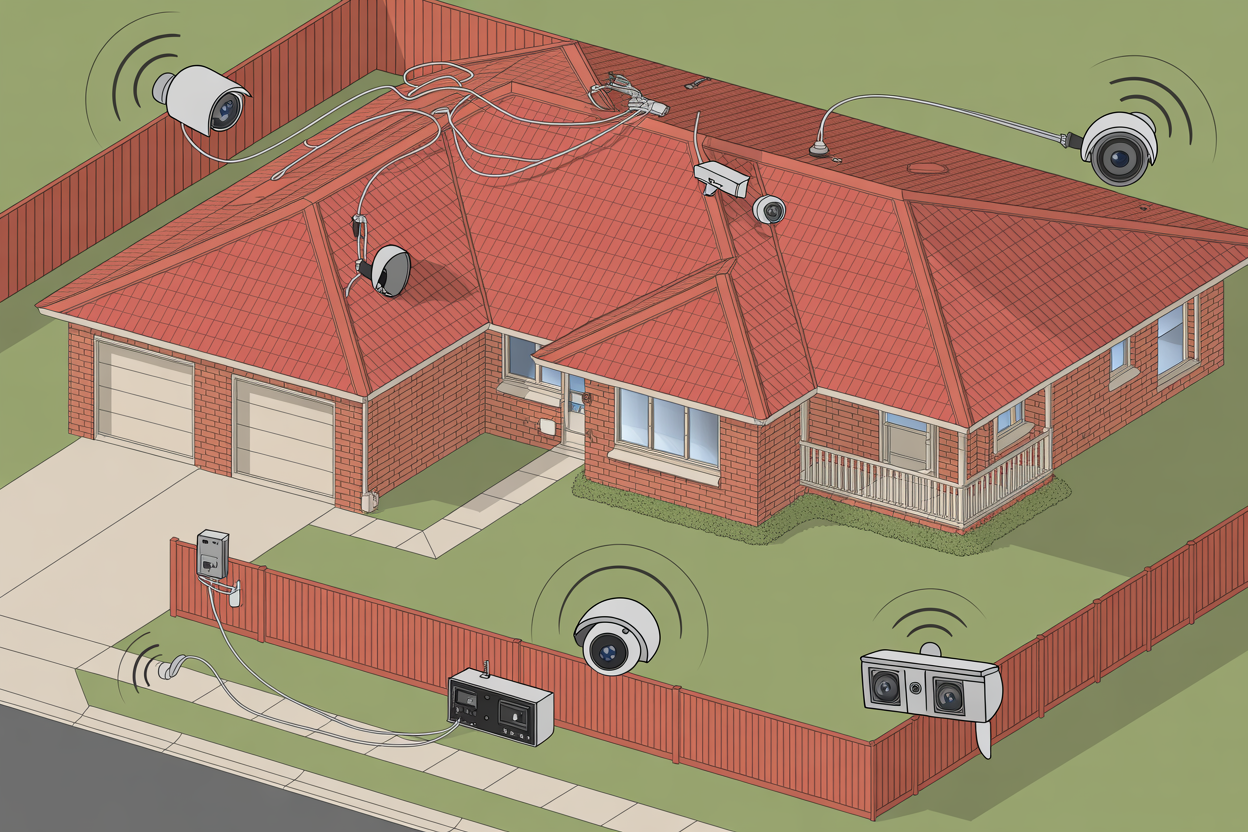
The most practical hybrid setup uses wired cameras on all primary entry points — front door, back door, side gate, driveway — where continuous recording matters most. Battery cameras then cover the blind spots that would be complex to cable: a detached garage, letterbox zone, pool gate, or back corner of a larger block.
A good professional installer can design this from the start — sizing the NVR correctly, identifying which positions need wired coverage and which are suited to battery, and making sure the whole thing runs through a single app.
DIY vs Professional Installation — Does It Change the Equation?
There's one more variable that changes things significantly: whether you install it yourself or bring in a professional.
What DIY Battery Installation Actually Involves
Battery camera installation is accessible for most homeowners. You unbox the cameras, download the app, connect to WiFi, and mount the units — most brands offer adhesive or screw mounts without major drilling.
That's the easy part. What's harder to see is what you might get wrong. Camera placement is a skill. Knowing the right angle to cover a driveway, recognising positions that'll be washed out by morning sun — these come from experience, not an instruction manual. Weak WiFi zones are another risk. A camera might connect fine during setup but drop connection once it's mounted in position. And there's no weatherproofing warranty when you self-install. If a camera fails after a Brisbane storm, you're dealing with the manufacturer's process alone.
What Professional Wired Installation Involves
A professional wired installation starts with a site assessment — walking the property, identifying entry points, blind spots, and cable routing options. That planning stage is where the quality of the outcome is largely determined.
Cable routing comes next: running ethernet through roof cavities and down internal walls. The NVR is then configured, cameras commissioned, remote viewing set up on your phone, and the full system tested before the installer leaves.
In Queensland, certain electrical work associated with camera installation requires a licensed electrical contractor. Always confirm your installer holds a current QBCC licence. Verify at qbcc.qld.gov.au.
The Hidden Cost of Getting It Wrong
A poorly placed camera that misses the entry point used in a break-in doesn't just fail to capture footage — it actively costs you. Insurance claims without supporting footage are harder to process. Queensland Police investigations without usable CCTV are harder to pursue. DIY cable routing in a Queenslander home can also cause wall damage requiring professional repair.
One missed incident because of a poorly positioned camera costs more than professional installation ever could.
Ready to Work Out Which System Suits Your Home?
You've now got a clear picture of how each system works, how they perform in Queensland conditions, and which type of property each one suits best.
For most Brisbane homeowners who own their property and plan to stay, a professionally installed wired system delivers better long-term value and more reliable coverage. The footage is yours, there are no ongoing fees, and a storm won't leave you with gaps in your recording history.
If you're renting, dealing with a hard-to-cable outbuilding, or need something in place quickly, battery cameras serve a genuine purpose — just go in with clear eyes about the ongoing maintenance and subscription dependency.
And if your property has both straightforward entry points and hard-to-reach spots, a hybrid system designed by an experienced installer gives you complete coverage without compromising where it counts.
Get Your Free Brisbane Home Security Assessment
We'll tell you exactly which system suits your property — wired, battery, or hybrid.
Book My Free Assessment
No obligation. Serving Brisbane's northern and southern suburbs.