Fast-Track Office Building Camera Installation Brisbane
Managing security across multiple office buildings shouldn't mean juggling different contractors, incompatible systems, and endless coordination headaches. Yet that's exactly what most property portfolio managers face when trying to protect their commercial assets.
Property A needs footage urgently for a police report, but the contractor takes forever to respond. Property B has crystal-clear 4K cameras while Property C runs grainy footage from years ago. A tenant at Property D raises security concerns during lease negotiations, and you're scrambling with unfamiliar vendors. Meanwhile, you're paying vastly different rates for basically the same service across your portfolio, and nobody can explain why.
Whether you're overseeing CBD towers, business parks in Fortitude Valley, or professional suites across Brisbane's suburban corridors, your office buildings need consistent, reliable camera coverage that works together—not against you. Most security companies approach each building like a standalone project. They don't understand that you're managing a portfolio where standardization, predictability, and centralized control are absolute requirements, not nice-to-have features.
Here's what makes office building camera installation fundamentally different from other commercial properties. You're dealing with multi-tenanted environments where a law firm on level 8 has completely different security needs than the tech startup on level 3. You've got common areas requiring 24/7 coverage, private spaces with strict privacy requirements under Queensland legislation, parking structures with documented vehicle theft risks, and after-hours access for cleaning crews, maintenance contractors, and late-working tenants. Somehow, you need to make all of this work seamlessly across every property in your portfolio without becoming a full-time security systems manager yourself.
This guide reveals how property managers are achieving institutional-grade security across their Brisbane office portfolios without the complexity that typically comes with multi-building implementations.
What Is Office Building Camera Installation?
Office building camera installation is the professional deployment of commercial-grade CCTV systems across multi-tenanted properties, providing comprehensive security coverage for common areas, entry points, parking facilities, and tenant spaces.
A complete installation includes:
Site assessment and camera placement strategy - Identifying coverage zones across lobbies, corridors, lifts, stairwells, and exterior areas
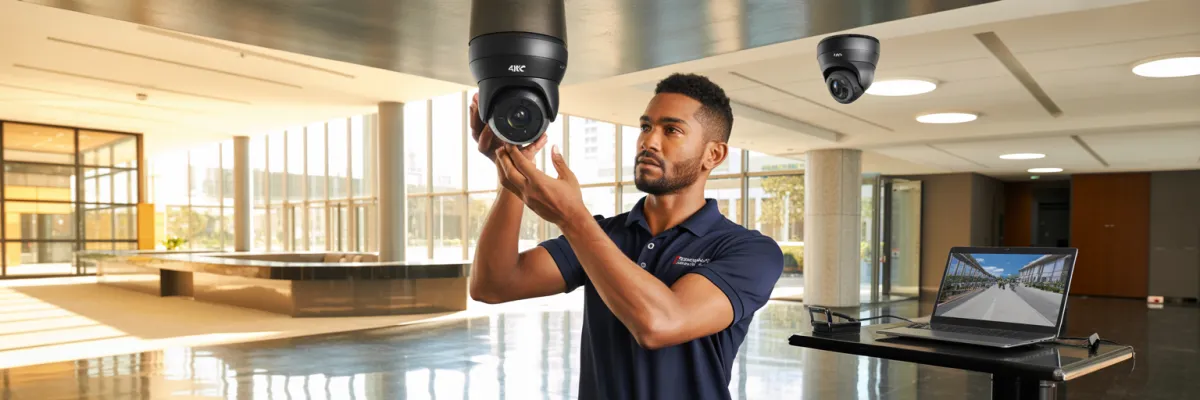
High-resolution IP camera installation - 4K cameras with night vision and wide-angle coverage for optimal evidence quality
Network infrastructure setup - Connecting all cameras to centralized recording and monitoring systems
Centralized management platform - Cloud-based access allowing property managers to monitor multiple buildings from one dashboard
Integration with access control systems - Coordinating camera coverage with building entry and security protocols
Ongoing maintenance and support - Regular system health checks and technical support

Why Office Buildings Need Specialized Camera Installation (Not Generic CCTV)
You can't just treat an office building like it's a warehouse with cubicles. The security requirements are completely different, and trying to apply generic CCTV approaches to multi-tenanted office environments is how you end up with coverage gaps, privacy complaints, and footage that's useless when you actually need it.
Multi-Tenancy Security Complexity
Office buildings aren't warehouses with cubicles. Every floor is its own ecosystem with unique requirements. Law firms need discreet coverage protecting confidentiality. Tech startups want equipment protection without oppressive surveillance. Medical practices have strict privacy requirements under Australian regulations.
Common areas need careful planning. Lobbies require high-resolution coverage for visitor verification. Corridors and lifts need blind spot coverage without making tenants feel constantly watched. Stairwells need safety and liability protection with properly positioned cameras.
After-hours complexity includes cleaning crews, maintenance contractors, late-working tenants, and delivery drivers. Each scenario needs appropriate camera coverage verifying legitimate access without creating privacy concerns.
Privacy compliance isn't optional. You need clear policies on what gets recorded, retention periods, access rights, and tenant-specific industry regulations. Queensland privacy laws require proper documentation.
Office Building Vulnerabilities That Create Risk
Queensland Police Service data shows hundreds of reported commercial property incidents in Brisbane CBD and surrounding office precincts annually. That's only reported incidents—the real number is substantially higher when you account for unreported theft, vandalism that gets written off as maintenance expenses, and incidents that tenants handle privately without involving property management or authorities.
Parking structures represent the most common vulnerability point for after-hours property crimes, vehicle break-ins, and theft incidents. The typical multi-level office building parking structure has numerous factors working against security: multiple levels creating vertical complexity, low lighting conditions especially in corners and stairwells, limited natural surveillance from passersby, and dozens of potential hiding spots behind columns and vehicles. Peak incident times cluster between evening and late night when workers have left but before overnight security patrols increase presence. Without proper camera coverage showing clear footage of license plates, faces, and vehicle activity patterns, identifying offenders or recovering stolen property becomes nearly impossible. Insurance claims get complicated when footage quality is inadequate or coverage has blind spots.
Lift and stairwell blind spots create significant liability exposure that property managers often underestimate. Someone gets assaulted in a stairwell with no camera coverage? That's a lawsuit waiting to happen, and your insurance company's gonna have serious questions about why adequate security measures weren't in place. Someone claims they slipped in a lift lobby during after-hours cleaning? Without footage, it becomes their word against yours, and juries tend to side with injured parties. The financial impact of a single liability claim can easily exceed the complete cost of a comprehensive camera system for an entire building, making security infrastructure insurance rather than expense.
Loading docks and service entries are consistently forgotten during security planning despite representing significant vulnerability zones. These areas typically have minimal supervision during business hours and virtually none after hours, inconsistent access control with doors propped open for convenience, and convenient access to valuable equipment, sensitive building systems, or secure areas. Contractors, delivery drivers, and service personnel come and go throughout the day with varying levels of authorization verification. Without camera coverage documenting who was where and when, determining responsibility when equipment goes missing or unauthorized access occurs becomes impossible.
Property Value and Tenant Retention Impact
Here's something most property managers don't fully appreciate until they experience it firsthand: security infrastructure directly impacts your ability to attract and retain premium tenants in competitive markets. When that high-value tech company or professional services firm is choosing between your building and the one down the street, documented security coverage becomes a legitimate decision factor alongside square footage, fit-out costs, and location convenience. They're not just asking about parking spots and internet connectivity—they're specifically inquiring about security systems, camera coverage zones, after-hours access control protocols, and incident response procedures.
Lease negotiations gain considerable leverage when you've got comprehensive, documented security infrastructure to demonstrate. Premium tenants have come to expect premium security as baseline, and being able to show prospective lessees exactly what coverage exists, how the systems work across all entry points and common areas, and what documented protocols are in place for footage access and incident response gives you tangible advantages during negotiations. It's also a powerful retention tool during lease renewals—tenants who feel genuinely secure in your building and have experienced responsive security management are significantly more likely to renew than tenants who've experienced security incidents without adequate resolution or have ongoing safety concerns that property management hasn't addressed.
Insurance premium reductions represent real and significant financial benefits that compound annually. Commercial property insurers consistently offer substantial premium reductions—often in the range of 15-25% of annual premiums—for buildings with comprehensive, professionally installed camera systems that meet their coverage and quality standards. This isn't marketing fluff or vague promises; this is actual savings reflected in insurance renewal quotes and documented in policy amendments.
Property valuations also increase measurably when you've got properly documented security infrastructure. Commercial property appraisers increasingly recognize modern security systems as value-adding infrastructure investments rather than merely operating expenses that provide no asset value. The market has shifted—what was considered premium security infrastructure five years ago is now baseline expectation for quality office buildings in Brisbane's competitive precincts like Fortitude Valley, CBD, and major business parks.

The Portfolio Manager's Dilemma: Single Vendor vs. Multiple Contractors
If you're managing more than a couple office buildings in Brisbane, you've probably already lived this nightmare: different security contractors at different properties, incompatible systems that don't talk to each other, and you spending way too much time playing coordinator instead of actually managing properties.
The Hidden Costs of Fragmented Security Systems
Managing multiple contractors across your portfolio means endless vendor coordination instead of property management. A tenant needs footage urgently for a police report. The contractor doesn't respond for hours or days. Meanwhile, your tenant's frustrated and you look incompetent.
Touring a prospective tenant through one property with excellent cameras, then admitting your other buildings run outdated systems doesn't inspire confidence. Price variations for identical services across properties make no sense, yet vendors can't explain them. The administrative burden of tracking different contracts, renewal dates, and vendor contacts consumes time better spent on actual property management.
Standardization Benefits Across Multiple Office Buildings
Imagine this alternative scenario: single platform covering all properties across your entire portfolio. Whether you're checking your Fortitude Valley building, your Milton business park, or your CBD tower, it's the same interface, same login credentials, same process for accessing footage or checking system status. You can literally pull up all your buildings on your phone screen simultaneously and see what's happening across your entire portfolio in real-time without switching between systems or remembering different access procedures.
The tenant experience becomes genuinely consistent across your portfolio, which has more impact than most property managers initially realize. When tenants move between your buildings—which happens frequently in growing companies—or have colleagues in other properties you manage, they encounter the same security experience, same visitor procedures, same level of professionalism. That consistency builds confidence in your management quality and becomes a genuine competitive advantage when you're marketing vacancies or negotiating lease renewals. Prospective tenants touring multiple properties immediately recognize professional, uniform security as evidence of sophisticated property management.
Maintenance and upgrade costs transform from random, unpredictable expenses to predictable, budgetable line items. You negotiate one comprehensive service agreement covering all properties. When technology upgrades happen—and they will as camera technology continues advancing—they roll out across your portfolio at volume rates instead of individual building pricing. Firmware updates, system improvements, and feature additions get deployed uniformly instead of creating a patchwork of different system capabilities across your buildings.
The vendor management simplification alone justifies standardization for many portfolio managers. One phone number for all security issues across all properties. One point of contact who knows your entire portfolio intimately. One service level agreement with clear response time commitments. When something needs attention at any property—camera malfunction, footage request, system question—you call the same team who already knows your portfolio inside and out, understands your specific requirements and tenant sensitivities, and has direct accountability for service quality across all locations simultaneously.
Property managers consistently report substantial time reductions—often exceeding 60%—in time spent managing security systems after standardization versus fragmented multi-vendor approaches. Response times for tenant footage requests improve dramatically because you're not hunting down different contractors, figuring out different system interfaces, or discovering the contractor for that particular building is unavailable. Tenant satisfaction scores show measurable increases when they experience consistent, reliable security across portfolio properties rather than wildly varying quality and responsiveness depending on which building they're in.
Brisbane Office Building Camera Installation: Coverage Requirements by Zone
Office buildings are collections of different zones with different security needs, risks, and compliance requirements. Exterior coverage must capture all entry and exit points, loading dock activity, building perimeter, and comprehensive parking structure coverage including license plate recognition.
Common areas require strategic camera placement. Lobbies need high-resolution cameras positioned for facial identification. Corridors track tenant movement without capturing workspace activity. Lifts and stairwells provide confined space security and liability protection. Amenities, mailrooms, and package delivery areas need appropriate coverage balancing security with privacy.
Tenant-specific installations require tailored approaches. Medical practices, legal firms, and financial services have specialized security and compliance needs. Co-working spaces need security without oppression. Server rooms and IT infrastructure deserve dedicated coverage.
Technology Selection for Multi-Storey Office Buildings
IP camera systems are the only choice for managing multiple buildings long-term. Analog systems have lower upfront costs but hit hard limits requiring new equipment for each building. IP systems are infinitely expandable—new buildings connect to existing platforms seamlessly.
Image quality matters. 4K cameras deliver identification-quality footage where lower resolution shows blurry faces. Future-proofing means IP technology keeps advancing with upgrades possible without replacing entire infrastructure.
Centralized management platforms deliver real value. View all buildings from single interface, switch between properties instantly, search historical footage across entire portfolios, and monitor everything without juggling systems. Mobile apps mean managing security anywhere, anytime.
Smart analytics distinguish between security concerns and irrelevant movement, dramatically reducing false alarms. People counting informs HVAC optimization and space utilization. License plate recognition automates parking management. Loitering detection catches potential issues before escalation.

Choosing the Right Office Building Camera Installation Partner
Portfolio-scale experience separates contractors who understand portfolio management from those handling individual buildings. Multi-property installation requires coordination capabilities, centralized platform expertise, and service infrastructure single-building contractors don't develop.
Commercial property references verify local market knowledge and proven capability. Property management industry relationships provide credibility—contractors with strong reputations get referred repeatedly.
Ask these questions: How many multi-building portfolios have you completed? Can I speak with current portfolio manager clients? What centralized management platform do you provide? What's your emergency response time? How do you handle after-hours installation?
Red flags include residential-focused installers without commercial experience, no portfolio-level pricing structures, limited service areas, no centralized monitoring platforms, and unclear warranty terms.
Conclusion: Transform Your Portfolio Security Management Today
Managing office building security across multiple properties doesn't have to be complicated or time-consuming. The difference between fragmented security creating headaches and centralized systems that work comes down to choosing the right technology, working with partners who understand portfolio management, and making decisions based on long-term value.
Technology exists today to monitor all your office buildings from a single dashboard. Installation processes deploy comprehensive coverage without disrupting tenants. Volume pricing structures make portfolio-wide standardization affordable. Compliance frameworks protect you under Queensland privacy laws while delivering needed security coverage.
You can keep managing different contractors, dealing with incompatible systems, spending excessive time on security coordination, and hoping footage is available when needed. Or standardize your security, reclaim your time, improve tenant satisfaction, and position properties as premium offerings.
The choice isn't about cameras and installation—those are just tools. It's about whether security infrastructure works for you or against you. Whether you're managing a portfolio or being managed by it. Whether tenant concerns become quick footage retrievals or multi-hour coordination nightmares.
Start with assessment. No obligation, no pressure, just honest evaluation of where your portfolio stands and what improvements make sense.