Best Warehouse Security Camera Installation Brisbane 2026
Managing warehouse security across multiple properties shouldn't feel like coordinating a small army. Yet most property portfolio managers face exactly that challenge—juggling different security systems, monitoring separate platforms, and dealing with inconsistent coverage.
Queensland commercial property crime costs businesses significantly each year, with warehouses representing a substantial portion of commercial break-ins. For portfolio managers, a single security incident can trigger insurance claims, tenant disputes, and vacancy concerns that ripple across your entire investment.
This guide addresses the unique challenges of warehouse security camera installation Brisbane for property portfolios. You'll discover how to implement scalable security solutions that protect your assets, satisfy tenants, and provide centralized oversight—without managing multiple vendors or incompatible systems.
What Type of Security Cameras Are Best for Warehouses?
The best security cameras for warehouses depend on facility size, coverage needs, and monitoring requirements.
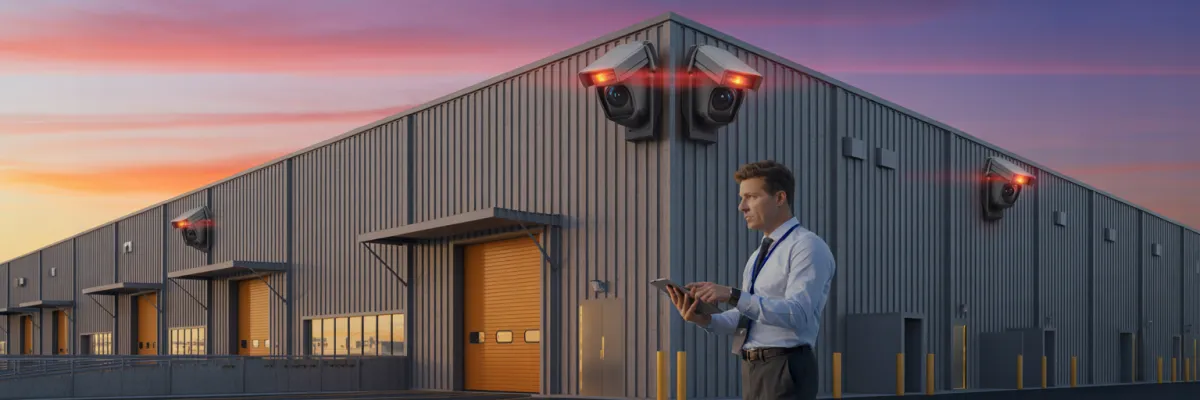
PTZ (Pan-Tilt-Zoom) Cameras offer 360-degree coverage for large open spaces, reducing total camera count. They're remotely controlled for investigating incidents and work best for high-value storage areas and loading docks.
Bullet Cameras with Varifocal Lenses are perfect for perimeter monitoring and entry points. Weather-resistant housing handles subtropical climates, while adjustable focal lengths work across varying distances. They're cost-effective for multi-property portfolios.
Fisheye Cameras provide single-camera coverage for warehouse corners with 180-degree or 360-degree fields of view. They reduce installation costs and work well for monitoring high-bay storage areas.
Thermal Cameras detect intruders in complete darkness without infrared illuminators. They're required for high-security facilities storing pharmaceuticals or electronics.
For portfolio managers, standardizing camera types across properties simplifies maintenance, reduces spare parts inventory, and enables consistent security coverage regardless of facility size.

Understanding Portfolio Security Requirements
Environmental Challenges
Industrial areas present distinct security profiles with varying crime rates. Queensland Police data shows commercial break-ins in certain postcodes run significantly higher than averages, with most incidents happening overnight when facilities are unmanned.
The subtropical climate actively destroys electronic equipment. Humidity causes premature camera failure if you're not speccing the right equipment. Storm exposure creates lightning-induced power surges that can destroy entire systems. Warehouse roof spaces reach extreme temperatures during summer, exceeding the operating temperature of standard security cameras.
Standardization vs. Flexibility
If your portfolio includes different-sized facilities, security solutions that work for one don't scale appropriately for others. The tension is wanting standardization for easier management but needing flexibility for different property types.
Your tenant mix complicates this. Warehouses with single tenants have different security priorities than multi-tenant properties. Single tenants want comprehensive internal monitoring, while multi-tenant facilities need careful privacy considerations and clear delineation of common area coverage.
Centralized Monitoring
Single-warehouse operators can use standalone systems. Portfolio managers can't. You need every property feeding into a centralized platform for monitoring all locations simultaneously. This isn't just convenience—it's about response time and liability management.
When you get an overnight alert, you need to immediately know which property triggered it, see live footage, and assess whether it's genuine or a false alarm. Managing separate credentials, different apps, and incompatible systems means you're slower to respond.
Selecting Camera Systems for Portfolios
Camera Selection Strategy
PTZ cameras work for massive warehouse floors where you'd otherwise need multiple fixed cameras. They rotate, tilt, and zoom remotely. The downside is complexity—moving parts require more maintenance, especially in humid conditions. For portfolio standardization, you're probably not using them at every property.
Bullet cameras are workhorses. They're weather-resistant and designed for outdoor mounting. The varifocal lens option makes them versatile—you adjust the field of view during installation. This means using the same camera model across different warehouses despite varying coverage requirements.
Fisheye cameras mount on ceilings providing wide-angle views. One fisheye can replace multiple fixed cameras in the right application. The trade-off is distorted images requiring video management systems that can "dewarp" footage into standard rectangular views.
Resolution and Storage
Standard HD resolution is outdated for commercial warehouse security. You want higher resolution for most applications, with premium quality for entry points, loading docks, and anywhere needing to read text or identify faces.
Your insurance provider and law enforcement need usable footage after incidents. If they can't make out license plates or identify individuals, the footage loses value.
Storage calculation gets complicated when managing multiple warehouses. The portfolio consideration is whether you're storing footage locally at each property or centralizing storage in the cloud. Local storage is cheaper upfront but creates operational complexity managing multiple recording devices.
The hybrid approach works well: local recording devices at each property for primary storage, with cloud backup for critical cameras.
Modern compression reduces file sizes significantly without sacrificing quality. For portfolio managers, this translates to storage cost savings and bandwidth efficiency when remotely accessing footage.
Video Management Systems
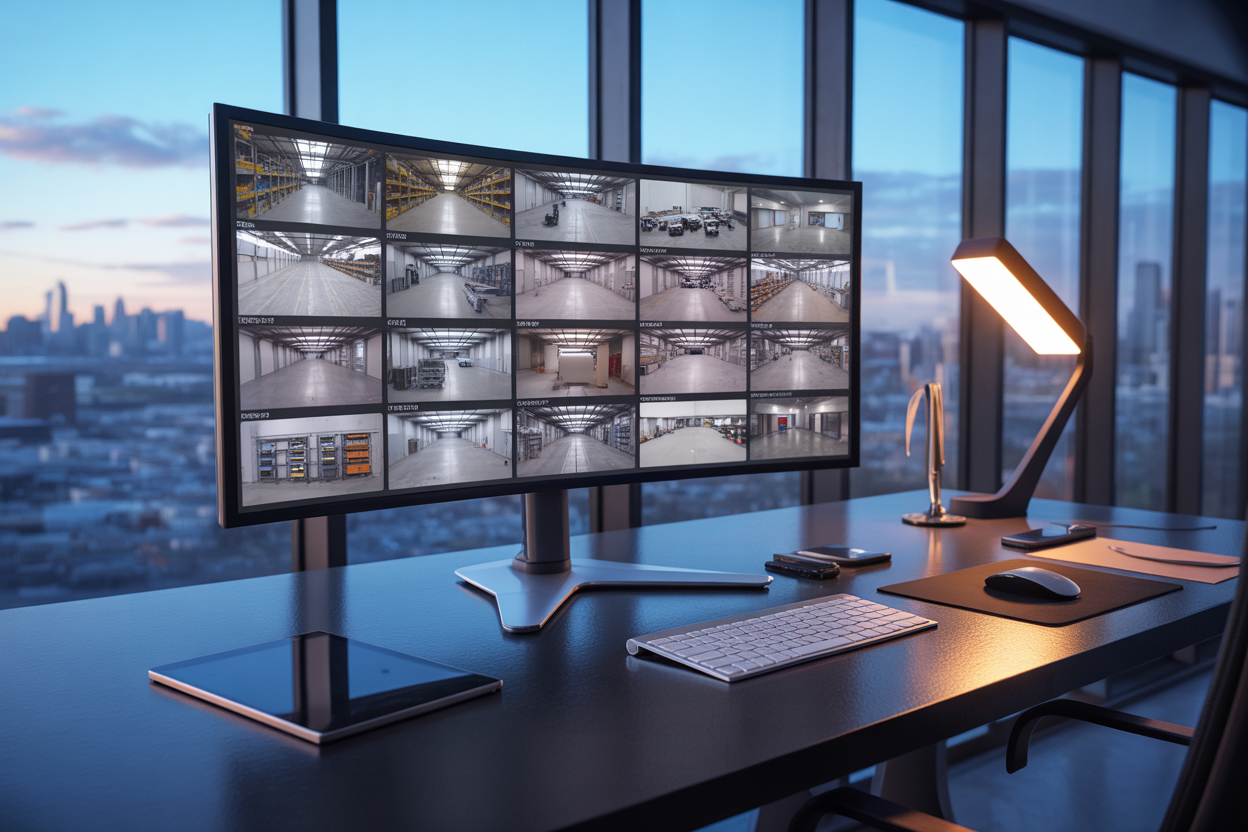
The VMS ties your entire portfolio's security infrastructure together. Without centralized management, you're running separate security systems at each property.
On-premise VMS means running server software at a central location connecting to all warehouses. Cloud-based VMS means the software and storage lives in the cloud, accessed through web interface or mobile app.
The hybrid approach: local recording at each property for reliability, with cloud management interface for remote access. This gives you footage security if internet connections drop while maintaining centralized monitoring convenience.
You need mobile monitoring. Look for live view of any camera at any property, playback without needing a computer, push notifications for alerts, and ability to share footage clips directly from the app.
Environmental Protection and Installation
Climate Considerations
High humidity year-round creates condensation inside camera housings, corrodes circuit boards, and fogs lenses. IP ratings tell you how cameras resist moisture and dust. IP65 is minimum, but IP67 or IP68 is better. IP67 means the camera can be submerged in water without damage.
During summer storms, water comes in sideways. Warehouses deal with driving rain that finds every gap in camera housings. Housing material matters—plastic expands and contracts with temperature changes, eventually breaking seals. Marine-grade stainless steel or treated aluminum provides long-term reliability.
Intense electrical storms destroy unprotected systems. Every camera connection needs surge protection—at the camera itself, not just at the recording device. Warehouses with metal roofing are particularly vulnerable. Your electrical contractor needs to verify proper grounding and install whole-building surge protection.
Warehouse roof spaces hit extreme temperatures. Standard cameras have operating maximums that get exceeded. If you're mounting cameras in ceiling spaces or under metal roofs, you need cameras rated for extended temperature ranges.
Structural Mounting
Many warehouses have ceiling heights of multiple stories. Mounting cameras at those heights creates challenges getting adequate image detail, securing mounting hardware to structural elements, and providing maintenance access.
Suspended pole mounts drop cameras down from ceiling structures, reducing effective height. Wall-mounting cameras along perimeters provides better image detail and easier maintenance access. Column mounting works for warehouses with regular support columns.
Running cables in warehouses requires different thinking than office spaces. You're dealing with forklift traffic, overhead cranes, temperature extremes, and potential physical damage from operations.
Conduit is non-negotiable. Exposed cables deteriorate quickly. Metal conduit provides physical protection and looks professional. For portfolio standardization, specify conduit installation as mandatory. Routing paths need to avoid operational areas where forklifts might contact cables.
Compliance and Privacy
Queensland Regulations
The Invasion of Privacy Act makes it an offense to record private activities without consent. Commercial properties have lower privacy expectations—employees and visitors in commercial environments generally don't have reasonable privacy expectations in common areas.
You can't record anywhere people have legitimate privacy expectations. Bathrooms, change rooms, first aid rooms, and designated break areas are off-limits.
For multi-tenant warehouses, privacy gets complex. You need cameras covering common loading docks and corridors but can't position them to monitor individual tenant operations inside leased spaces.
Visible signage is your first line of compliance defense. Courts generally uphold surveillance footage as evidence when adequate notice was provided. Sign placement should be at every entry point—vehicle gates, pedestrian doors, loading dock entries.
Use professional signage that's weather-resistant, clearly legible from reasonable distances, and mounted at eye level where people naturally look as they enter.
Data Management
Minimum retention period for commercial warehouse security is typically around a month. Many incidents aren't discovered immediately—theft might not be noticed for days or weeks, particularly in warehouses with large inventories.
When security incidents occur, you need procedures for preserving footage beyond normal retention periods. Create a standard procedure: immediately export and preserve relevant footage when incidents are reported, mark footage with incident reference numbers, and store preserved footage separately.
Implementation Strategy
Phased Rollouts
Rolling out security systems across your portfolio doesn't need to happen all at once. A phased approach gives you flexibility and lets you learn from early installations before scaling.
Start by ranking warehouses based on security risk factors. Properties with recent incidents top the list. Also consider location-specific crime rates, tenant concerns, properties storing high-value goods, and warehouses with upcoming lease renewals where security might be a negotiation point.
This approach spreads capital expenditure. It also gives you early wins—addressing highest-risk properties first provides immediate security improvement where it's most needed.
Before installing anything anywhere, nail down portfolio-wide standards. This is where many portfolio managers make mistakes—they let installers propose different solutions for each property, ending up with incompatible systems.
Your standardization document should specify approved camera models, video management system platform, recording and retention requirements, network infrastructure standards, and installation quality expectations.
Send tenants written notice before installation dates. Explain what's happening, why you're doing it, what areas will be covered, what areas won't be covered (respecting privacy), and the installation timeline. Make crystal clear that cameras cover common areas, not the interior of leased spaces.
Vendor Selection
Ask potential vendors: how many multi-property security installations have you completed? You want vendors who've handled multiple property portfolios. Portfolio work requires different project management capabilities than single-site jobs.
Request references from other portfolio clients. Call those references and ask about installation quality consistency, scheduling coordination, and ongoing service.
Your vendor should hold Australian Security Industry Association (ASIAL) membership and relevant Queensland licensing. QBCC licensing is required for electrical and cabling work.
The vendor needs public liability insurance, professional indemnity insurance, workers compensation insurance, and contract works insurance.
The service agreement defines your relationship after installation. Get specific commitments in writing: emergency response time, business hours support, after-hours emergency contact procedures, preventive maintenance frequency, and escalation procedures.
For portfolio managers, response time commitments should apply across all properties equally.
Maximizing Security Value
Operational Benefits
Security cameras aren't just loss prevention tools—they're operational assets providing value beyond catching criminals.
Your cameras document contractor arrival times, activities, and departure times without needing property managers physically present. This proves valuable when disputes arise. For portfolio managers, cameras enable remote verification instead of driving to properties.
Camera footage creates objective records preventing property condition disputes with tenants. During tenant move-ins, property managers can walk through premises recording from security cameras to document condition. During move-outs, repeat the process. For common area damage, footage often captures when and how damage occurred.
Camera footage dramatically strengthens insurance claims for property damage, theft, or liability incidents. Insurers settle claims faster and more favorably when you provide video evidence. For theft claims, footage showing break-in methods and what was stolen creates compelling evidence. Liability claims benefit similarly—footage might show incidents happened differently than claimed.
Marketing Advantages
When prospective tenants tour multiple similar warehouses, security infrastructure becomes a differentiator swaying their decision toward your property. Highlight security features in marketing materials. During tours, demonstrate the system. Show camera coverage, explain retention periods, describe how they can request footage.
The security investment also signals property management quality. Tenants recognize that landlords who invest in comprehensive security likely maintain other property systems properly.
Warehouses with documented security infrastructure can command rental premiums compared to similar properties without security systems. The premium works because tenants pass security costs to you through higher rent rather than installing their own systems.
Properties with comprehensive security lease faster than comparable properties without security. Security infrastructure attracts more prospective tenant inquiries, broadening your tenant pool. Security also reduces tenant hesitation during decision-making—one less concern before signing leases.

Taking Action
You've now got the complete picture of what warehouse security camera installation looks like at portfolio scale. Not the sanitized marketing version where everything's simple—the real version where environmental challenges, vendor management, tenant relationships, and long-term considerations all factor into decisions.
Here's what separates successful implementations from expensive mistakes: planning before purchasing. Portfolio managers who regret their investments usually treated each warehouse as a separate project, accepted whatever installers proposed, and didn't think through standardization until they were managing multiple incompatible systems.
Start with a security risk assessment across all warehouses. Which properties have highest crime exposure? Where have tenants raised concerns? Which warehouses store the most valuable goods?
Get your standardization specifications documented. Sit down with your team or engage a security consultant who understands portfolio work and create equipment standards, coverage requirements, and installation quality expectations.
Interview multiple security vendors with demonstrated portfolio experience. Find vendors who've deployed security across multiple portfolios and ask for references you can actually call.
Build your implementation timeline. Maybe you're doing all properties simultaneously if budget allows. More likely you're phasing installations, prioritizing based on risk assessment while spreading expenditure.
Don't underestimate environmental challenges. Humidity, storms, and heat are active threats to equipment longevity. Your equipment specifications need high IP ratings, appropriate housings, comprehensive surge protection at every camera, and temperature ratings exceeding standard commercial specs.
You're entering a multi-year partnership where this vendor will support your infrastructure across multiple properties, handle emergency repairs, and potentially expand systems as your portfolio grows. Choose vendors you can work with long-term. Get specific commitments in writing—response times, service agreements, maintenance schedules, warranty coverage.
The difference between portfolio managers who achieve great security outcomes and those who end up frustrated comes down to treating security as strategic infrastructure rather than tactical purchases. Strategic infrastructure gets planned portfolio-wide, standardized across properties, and managed through long-term vendor partnerships.
Your warehouse portfolio deserves security infrastructure that matches your management sophistication. Tenants expect security that protects their operations and gives them confidence in your property management capabilities.
Start the planning process now. Security risks don't wait for convenient timing—break-ins happen, liability incidents occur, and tenant concerns arise regardless of whether you've implemented proper infrastructure.
Portfolio managers who'll look back satisfied with their security investments are the ones who start taking action. They'll contact vendors. They'll get proposals. They'll begin installations. And they'll have portfolio-wide security providing tangible value through reduced claims, satisfied tenants, insurance savings, and peace of mind that their property investments are properly protected.
You've got the knowledge. Now execute the plan and get your warehouse portfolio secured properly.